When you’re chatting with a friend on WhatsApp, scrolling through Instagram comments, or talking to someone on TikTok, you might receive a short message that simply says, “Huh?” At first, it can be difficult to tell what the other person means. Are they confused, surprised, annoyed, or asking you to repeat something?
The good news is that “huh” is a common conversational expression used to show confusion, ask for clarification, or express surprise. Its exact meaning depends on the conversation, the punctuation, and the relationship between the people chatting.
Understanding the huh meaning in text can help you avoid misunderstandings and respond naturally. Unlike many internet abbreviations, “huh” isn’t usually an acronym with a full form. It’s an informal expression that people use in everyday conversations, both online and offline.
What Does “Huh” Mean in Texting?
In texting, “huh” usually means “What?”, “I don’t understand,” or “Can you explain that again?” People use it when something surprises them, sounds confusing, or doesn’t make sense.
For example:
- Friend: “I’m moving to another city next week.”
- You: “Huh? Since when?”
Here, “huh?” expresses surprise and asks for more information.
In another conversation, it might mean something slightly different:
- Friend: “The meeting starts at 8 AM tomorrow.”
- You: “Huh? I thought it was at 10.”
In this example, “huh?” shows confusion because the information doesn’t match what you expected.
The important thing to remember is that “huh” doesn’t have one fixed emotional meaning. It can communicate several reactions depending on how it’s written and what was said before it.
The Most Common Meanings of “Huh”
Here are the main ways people use the expression in text messages.
- Confusion: You don’t understand what someone said.
- Surprise: Someone shares unexpected news.
- A request for repetition: You didn’t hear, read, or understand something clearly.
- Curiosity: You want the other person to explain something.
- Disbelief: Something sounds unusual or difficult to believe.
- Mild annoyance: You’re frustrated because a message doesn’t make sense.
- Sarcasm: You’re pretending not to understand something to make a point.
For example, if someone texts “Huh?” after you send an unclear message, they’re probably asking you to explain. If they respond with “Huh…” after hearing surprising news, they might be processing what you’ve told them.
So, when someone searches for the huh meaning in text, the simplest answer is that it’s an informal reaction used to express confusion, surprise, or a need for clarification.
Full Form or Expansion of “Huh”
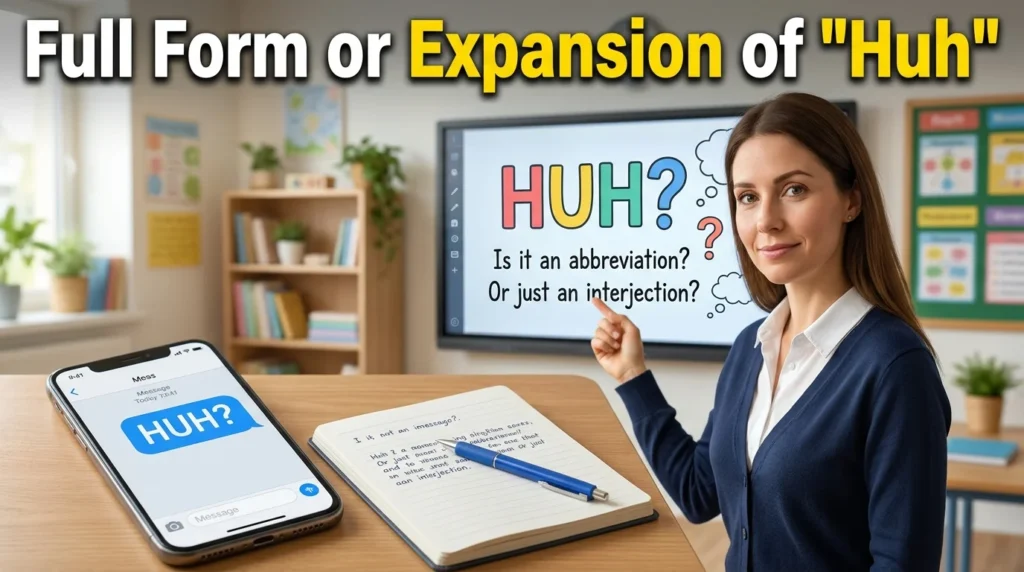
Unlike texting abbreviations such as LOL, BRB, or IDK, “huh” doesn’t have a standard full form. It is an interjection, which means a short expression used to communicate a reaction, feeling, or response.
Some texting terms are formed from the first letters of longer phrases. For example, IDK stands for “I don’t know.” Huh works differently because it is already a complete expression.
People generally write “huh” exactly as it sounds in conversation. They don’t need to expand it into a longer phrase to communicate their reaction.
Depending on the situation, “huh” can imply:
- “What did you say?”
- “I didn’t understand.”
- “Can you repeat that?”
- “Really? I wasn’t expecting that.”
- “That’s strange.”
- “Can you explain what you mean?”
These are possible interpretations rather than official expansions of the word.
Is “HUH” an Acronym?
No. In ordinary texting, “HUH” is not a recognized acronym with a standard expansion. Writing it in capital letters usually adds emphasis rather than creating a new abbreviation.
For instance:
- “Huh?” expresses a normal question or reaction.
- “HUH?!” communicates stronger surprise or disbelief.
- “huh…” can suggest hesitation, uncertainty, or thoughtfulness.
The capitalization and punctuation can change the tone, but they don’t give the expression a new official full form.
Where Is “Huh” Commonly Used?
One reason “huh” remains popular is that it’s short, familiar, and easy to type. People use it across different digital platforms, from private messages to public discussions.
1. WhatsApp Conversations
On WhatsApp, people often send “huh?” when they don’t understand a friend’s message or want clarification.
For example:
Alex: I’ll meet you there after the other thing.
Sam: Huh? What other thing?
Sam doesn’t understand what Alex means and wants a clearer explanation.
In WhatsApp chats, “huh” can be a natural response between friends, family members, partners, or group members. However, because text messages don’t include vocal tone, a bare “huh?” may sometimes sound impatient.
If you want to sound friendlier, you can write, “Huh? What do you mean lol?” or “Wait, I didn’t understand that.”
2. Instagram DMs and Comments
Instagram users may use “huh” when reacting to confusing messages, unexpected statements, or unusual posts.
For example, someone might comment “Huh?” under a post that contains an unexpected opinion or confusing caption.
In direct messages, it might appear when someone shares surprising news or makes an unclear joke.
The meaning depends on the surrounding conversation. A curious “huh?” isn’t necessarily negative, but a sarcastic one may communicate criticism or disbelief.
3. TikTok Comments and Live Streams
On TikTok, “huh” frequently works as a quick reaction to something surprising, confusing, or unexpected.
Imagine a creator explaining an unusual life hack. A viewer might comment:
“Huh?? Does that actually work?”
Here, the expression shows surprise and curiosity.
During a live stream, viewers might also type “huh?” if they missed something the creator said or couldn’t follow the conversation.
Because TikTok comments are often short and spontaneous, “huh” can communicate a reaction without requiring a complete sentence.
4. Gaming Chats
Gaming conversations move quickly, so short expressions are especially useful.
Players may type “huh?” when a teammate gives unclear instructions, announces an unexpected strategy, or says something that doesn’t fit the situation.
For example:
Player 1: Rotate to the other side now.
Player 2: Huh? We’re already there.
In this example, the second player is confused about the instruction.
Gamers may also use “huh” sarcastically after an opponent makes an unusual move. The expression doesn’t have a special gaming-specific full form; it retains its ordinary conversational meaning.
5. Online Forums and Discussion Boards
On forums, “huh” can introduce a question or indicate that a post is difficult to understand.
For example:
” Huh, I never thought about it that way.”
In this sentence, the expression suggests that the writer has encountered an interesting idea and is reconsidering their perspective.
A different example would be:
“Huh? That explanation doesn’t match the information in the first post.”
Here, the writer is pointing out a possible contradiction.
On discussion platforms, context is especially important because a short response may be interpreted as disagreement even when the writer simply wants clarification.
6. Group Chats
Group chats are another common place to encounter “huh.” People use it when they miss part of a conversation, don’t recognize a reference, or can’t understand an inside joke.
For instance:
Mia: Remember what happened at the old place?
Noah: Huh? Which place?
Noah needs more information before he can follow the discussion.
In busy group chats, asking a short question can be more convenient than typing a long explanation. Still, if several people are talking at once, adding a little detail can make your question easier to answer.
Origin and History of “Huh” as a Texting Expression
“Huh” wasn’t invented by smartphones, social media, or modern texting culture. It’s a much older conversational expression associated with human speech.
People have long used short sounds to signal that they didn’t hear something clearly, want another person to repeat a statement, or feel surprised by new information.
Linguists study expressions like “huh” because they serve an important purpose in conversation: they help speakers manage misunderstandings and keep communication moving.
From Everyday Speech to Digital Messages
Before texting became popular, people already used “huh?” in face-to-face conversations. Someone might say it after hearing an unfamiliar word or an unexpected statement.
As written digital communication developed through online messaging, chat rooms, SMS, and social media, people began using the same expression in text form.
Its popularity makes sense for a simple reason: it communicates a reaction with very little effort.
Instead of writing, “I’m sorry, but I didn’t understand what you just said. Could you please explain it again?” someone can simply type “Huh?”
Did Texting Create the Word “Huh”?
No. Texting helped spread and normalize its written use, but the expression itself predates internet messaging.
It’s also important to distinguish “huh” from abbreviations that were created to save typing time. While LOL and BRB are commonly understood as shortened forms of longer phrases, “huh” is a standalone conversational expression.
There isn’t one universally accepted date when people first started using it in digital messages. Its development is better understood as an extension of ordinary spoken language into written communication.
Other Possible Meanings of “Huh”
Although confusion is the most common interpretation in texting, “huh” can communicate different reactions depending on the situation.
1. “Huh?” as a Request for Clarification
This is probably the most straightforward use.
Example:
“You need to submit the second form first.”
“Huh? Which form?”
The recipient doesn’t understand the instruction and asks for more details.
2. “Huh!” as Surprise
Sometimes “huh” signals that something is unexpected.
Example:
“You won the competition!”
“Huh! I wasn’t expecting that.”
The speaker expresses surprise rather than asking the other person to repeat themselves.
3. “Huh…” as Thoughtfulness
Adding an ellipsis can make the expression sound reflective or uncertain.
Example:
“Huh… maybe you’re right.”
The speaker is considering what the other person said.
However, an ellipsis doesn’t guarantee a thoughtful tone. Depending on the relationship and conversation, it can also suggest awkwardness or hesitation.
4. “Huh?” as Disbelief
When someone hears something difficult to believe, “huh?” can communicate doubt.
Example:
“You finished the entire project in one hour.”
“Huh? Seriously?”
The speaker wants confirmation because the statement sounds surprising.
5. “Huh” as Mild Annoyance
A short response can sometimes signal frustration.
Example:
“Why didn’t you tell me earlier?”
“Huh? I did tell you yesterday.”
Here, “huh?” introduces a defensive reaction. The speaker may feel that the other person’s statement is unfair or incorrect.
6. “Huh” as Sarcasm
In some conversations, people use “huh” to make a sarcastic observation.
Example:
“You said you’d arrive on time.”
“Huh, that’s interesting, considering you were late yesterday.”
In this case, the expression contributes to a sarcastic tone rather than simply asking for clarification.
Remember that these interpretations are contextual. The same word can sound friendly in one conversation and irritated in another.
How to Use “Huh” Correctly
Using “huh” is easy, but choosing the right tone matters. Since the expression is informal and can communicate different emotions, think about what you want the other person to understand.
Use “Huh?” When You’re Confused
If you don’t understand a message, “huh?” is a quick way to ask for clarification.
Example:
Friend: “Let’s do the usual thing tomorrow.”
You: “Huh? What are we doing tomorrow?”
This is appropriate when you’re chatting casually with someone who knows you well.
Use “Huh!” When You’re Surprised
An exclamation mark can emphasize a reaction.
Example:
Friend: “I got tickets to the concert!”
You: “Huh! That’s unexpected!”
In everyday texting, people might also write “Huh, really?” or “Huh, I didn’t know that.”
Use “Huh…” When You’re Thinking
An ellipsis can suggest that you’re processing information or aren’t entirely sure what to say.
Example:
Friend: “Maybe you should try a different approach.”
You: “Huh… that might actually work.”
This style is useful when you want to show that you’re considering someone’s suggestion.
Add Context When Necessary
A single word can be ambiguous. If you’re worried that “huh?” might sound rude, explain what confused you.
Instead of:
“Huh?”
Try:
- “Huh? What do you mean?”
- “Wait, I didn’t understand that.”
- “Huh? Can you explain?”
- “Sorry, what was that?”
- “Oh, I’m confused. Can you tell me more?”
These alternatives make your intention clearer.
Pay Attention to Punctuation
Punctuation influences how people interpret your message.
| Text message | Possible tone |
| Huh? | Confusion or a request for clarification |
| Huh! | Surprise or sudden realization |
| Huh… | Hesitation or reflection |
| Huh?! | Strong surprise or disbelief |
| HUH?! | Intense shock, confusion, or emphasis |
| huh lol | Casual confusion, often softened by humor |
These are common interpretations, not strict rules. A person’s normal texting style and the conversation itself can change how each message feels.
Example Conversations Using “Huh”
The following examples show how people might use “huh” naturally in everyday digital conversations.
Example 1: Asking What Someone Means
Jake: We need to change the plan.
Emma: Huh? Why?
Meaning: Emma doesn’t know why the plan needs to change and asks for an explanation.
Example 2: Reacting to Unexpected News
Liam: Sarah is moving to Canada next month.
Olivia: Huh? I thought she was staying here.
Meaning: Olivia is surprised because the news conflicts with what she previously believed.
Example 3: In a WhatsApp Chat
Ali: I’ll call you after the thing.
Hamza: Huh? What thing?
Ali: My driving lesson.
Meaning: Hamza needs more information because Ali’s first message is vague.
Example 4: In an Instagram DM
Maya: I finally met my favorite singer yesterday.
Zoe: Huh?! Where?
Maya: At the airport!
Meaning: Zoe is surprised and wants to know where the meeting happened.
Example 5: In a TikTok Comment
Creator: This is the easiest way to organize your room.
Viewer: Huh? How does that make it easier?
Meaning: The viewer is confused about the method and wants clarification.
Example 6: During a Gaming Session
Player 1: Don’t attack yet. Wait for my signal.
Player 2: Huh? I thought we were pushing now.
Meaning: Player 2 is confused about the current strategy.
Example 7: Showing Disbelief
Noah: I ran ten miles before breakfast.
Ethan: Huh? You’re serious?
Meaning: Ethan finds the statement surprising and wants confirmation.
Example 8: Thinking About an Idea
Sophie: What if we start our own small business?
Ava: Huh… that’s actually an interesting idea.
Meaning: Ava is considering the suggestion rather than rejecting it.
Example 9: Mild Frustration
Daniel: You never told me about the meeting.
Chris: Huh? I sent you the details yesterday.
Meaning: Chris is surprised and slightly defensive because he believes he already shared the information.
Example 10: Responding to a Joke
Ryan: I can eat an entire pizza by myself.
Ben: Huh lol, I need to see that happen.
Meaning: Ben reacts playfully and expresses disbelief in a friendly way.
Example 11: In a Group Chat
Nina: Everyone, we’re meeting at the second location.
Ella: Huh? What second location?
Nina: The café near the station.
Meaning: Ella missed an earlier detail and asks the group to clarify.
Example 12: Discovering Something New
Mark: Some people can learn a new language by practicing a little every day.
Peter: Huh, I never thought of it like that.
Meaning: Peter expresses interest and a small moment of realization.
These examples demonstrate that the meaning of “huh” comes from the situation as much as from the word itself.
What Does “Huh” Mean in Chat, WhatsApp, Instagram, and TikTok?
The basic definition stays the same across platforms, but the surrounding conversation can affect how it sounds.
Usually indicates confusion, a request to repeat something, or surprise in private messages and group chats. Friends may use it casually without intending to sound rude
Often appears in DMs and comments as a reaction to an unexpected statement, confusing caption, or surprising post.
TikTok
Commonly communicates surprise or confusion about a video, joke, opinion, or live-stream conversation.
Gaming and online chat
Helps players and participants quickly question unclear instructions or react to unexpected events.
When researching the huh meaning in text, don’t assume the platform creates a completely different definition. The expression generally carries the same core meaning across messaging apps and social networks.
The biggest difference is the situation in which people use it.
When NOT to Use “Huh”
Although “huh” is normal in casual conversation, it isn’t suitable for every situation. In professional or formal communication, it may appear too informal, abrupt, or unclear.
1. Professional Emails
Imagine your manager sends you instructions about a project. Responding with just “Huh?” could sound dismissive or unprofessional.
Instead, write:
“Could you please clarify the second step? I want to make sure I understand the instructions correctly.”
This communicates the same need for clarification in a respectful way.
2. Job Applications and Interviews
During a job interview, use a polite request if you don’t understand a question.
For example:
“Could you please repeat the question?”
Or:
“Would you mind clarifying what you mean by that?”
These responses sound more professional than “Huh?”
3. Conversations With Customers
If you’re communicating with a client or customer, clarity and courtesy are important.
Instead of saying “Huh?”, try:
“I’m sorry, could you explain that part in a little more detail?”
This makes it easier to resolve misunderstandings without creating an impression of impatience.
4. Serious or Sensitive Conversations
When discussing a serious problem, a short “huh?” may make the other person feel that you’re dismissing their concerns.
If you’re genuinely confused, acknowledge what they said and ask a specific question.
For example:
“I want to understand what you’re saying. Could you explain that part again?”
The general rule: Use “huh” freely in relaxed conversations when it fits your usual style. Choose clearer, more polite language when the situation requires professionalism, sensitivity, or precision.
Similar Texting Abbreviations and How “Huh” Is Different
Several other expressions can communicate confusion, surprise, or a need for clarification. However, each has its own tone and purpose.
| Expression | Meaning | How it’s different from “huh” |
| What? | Asking for information or repetition | More direct and sometimes more forceful |
| Wdym | What do you mean? | Specifically asks for an explanation |
| IDK | I don’t know | Communicates uncertainty rather than asking a question |
| LOL | Laughing out loud | Usually expresses amusement or softens a message |
| WTF | What the heck or a stronger, profane expression | Often conveys stronger shock, frustration, or disbelief |
| Hmm | Thinking or considering something | Usually signals reflection rather than confusion |
| Eh? | Asking for repetition or expressing uncertainty | Similar to “huh,” with regional differences in use |
| FR? | For real? | Usually asks whether surprising information is true |
| OMG | Oh my God | Expresses strong surprise, excitement, or shock |
| Pardon? | Asking someone to repeat or clarify | Generally sounds more polite or formal |
Huh vs. Wdym
“Huh?” usually indicates immediate confusion or surprise. “Wdym?” explicitly asks the other person to explain their meaning.
Example:
- Person A: “That was an interesting decision.”
- Person B: “Huh?” — Person B is confused or surprised.
- Person B: “Wdym?” — Person B wants to know exactly what Person A meant.
Huh vs. Hmm
“Huh” often signals that something doesn’t make sense or is unexpected. “Hmm” more commonly suggests thinking, hesitation, or consideration.
Example:
- “Huh? I thought you were leaving today.” — Confusion.
- “Hmm, maybe I’ll leave tomorrow instead.” — Thinking about a decision.
Huh vs. What?
Both can ask someone to repeat or explain something. However, “what?” can sound more direct, particularly when written without any additional context.
“Huh?” often feels conversational and spontaneous, while “What do you mean?” makes the request more explicit.
Huh vs. FR?
“FR?” is short for “for real?” and commonly asks whether something is true.
For example:
Friend: I got free tickets to the game.
You: FR?
Your response asks whether the news is genuine. By contrast, “Huh?” might indicate that you didn’t understand the statement or were surprised by it.
How to Respond When Someone Sends You “Huh”
If someone sends you “huh,” don’t automatically assume they’re angry or being rude. They may simply need you to explain what you said.
The best response depends on the message that came before it.
1. Explain What You Meant
If your previous message was unclear, rephrase it in simpler language.
Them: Huh?
You: I mean we should meet an hour earlier than planned.
This resolves the confusion without making the conversation awkward.
2. Repeat the Information
If the person missed a detail, provide it again.
Them: Huh? What time?
You: At 6 PM, not 7 PM.
A direct answer is often the easiest solution.
3. Give More Context
Sometimes your message makes sense to you but not to the recipient. Add the information they need.
Them: Huh? Which place?
You: The coffee shop next to the library.
This is especially useful when discussing plans, locations, or events.
4. Keep It Playful
If you’re chatting with a close friend and the situation is lighthearted, you can respond humorously.
Them: Huh?!
You: LOL, let me explain.
Or:
Them: Huh?
You: Wait, I made that sound way more confusing than I meant to.
Humor can keep the conversation relaxed, provided the other person is comfortable with it.
5. Ask What Confused Them
If you aren’t sure what they didn’t understand, ask a follow-up question.
Them: Huh?
You: Which part confused you?
This works well when you’ve already explained something and want to identify the misunderstanding.
6. Clarify Your Tone if Necessary
If someone interprets your own “huh?” as annoyance, you can explain your intention.
For example:
“Sorry, I wasn’t annoyed. I just didn’t understand what you meant.”
This is a simple way to avoid unnecessary conflict in text conversations.
Common Mistakes and Misunderstandings Around “Huh”
Even though “huh” is a simple expression, it can be misunderstood because written messages lack vocal tone and facial expressions.
Here are some common mistakes to avoid.
Mistake 1: Assuming It Always Means Anger
A person who texts “huh?” isn’t necessarily upset. They might be curious, confused, distracted, or surprised.
How to avoid it: Read the preceding messages and consider how the person usually communicates before assuming a negative intention.
Mistake 2: Treating It as an Acronym
Some internet expressions have official or widely recognized expansions, but “huh” generally doesn’t.
How to avoid it: Understand it as a standalone conversational expression rather than trying to assign a full form to every letter.
Mistake 3: Ignoring Punctuation
“Huh?”, “Huh!”, and “Huh…” can suggest different reactions.
How to avoid it: Consider punctuation alongside the context, while remembering that not everyone uses punctuation consistently.
Mistake 4: Assuming It Always Requests Repetition
Sometimes “huh” expresses disbelief or surprise rather than indicating that someone didn’t hear you.
How to avoid it: Look at the message itself. If the person understands what you said but finds it unexpected, they may be reacting emotionally rather than asking you to repeat it.
Mistake 5: Using It in Formal Communication
Sending “huh?” to a manager, teacher, or client may sound abrupt.
How to avoid it: Use phrases such as “Could you clarify that?” or “Could you please explain what you mean?”
Mistake 6: Sending Only “Huh?” When More Detail Is Needed
A one-word response can leave the other person unsure about what went wrong.
How to avoid it: Add a few words when possible, such as “Huh? Which date do you mean?”
Mistake 7: Confusing It With “Hmm”
“Huh” and “hmm” may both appear when someone is processing information, but they don’t always communicate the same thing.
How to avoid it: Remember that “huh” more often signals confusion or surprise, whereas “hmm” more often signals thought or hesitation.
Ultimately, understanding the huh meaning in text requires more than memorizing a definition. You also need to consider context, punctuation, and the relationship between the people involved.
FAQs About “Huh” Meaning in Text
1. What does “huh” mean in texting?
In texting, “huh” usually means “What?”, “I don’t understand,” or “Can you explain that again?” It can also express surprise, disbelief, curiosity, or mild annoyance, depending on the conversation.
2. What does “huh?” mean from a girl or a guy?
When a girl or a guy texts “huh?”, they may be confused, surprised, or asking you to clarify something. The word doesn’t automatically indicate romantic interest, anger, or any particular emotion. Look at the surrounding messages to understand the intended meaning.
3. What is the full form of HUH in chat?
“Huh” doesn’t have a standard full form in ordinary chat. It’s an interjection used to express confusion, surprise, or a need for clarification rather than an acronym formed from the initial letters of a longer phrase.
4. Does “huh” mean someone is angry?
Not necessarily. Someone might use “huh?” because they didn’t understand your message or because something surprised them. However, it can sound annoyed or defensive in certain situations. Context and the person’s usual texting style help you interpret the tone.
5. What is the difference between “huh” and “what”?
Both expressions can communicate confusion or ask someone to repeat something. “Huh?” often sounds like a spontaneous conversational reaction, while “what?” can be more direct. Neither word is inherently rude, although either may sound impatient in the wrong context.
6. Is “huh” rude to use in text messages?
No, “huh” isn’t inherently rude. It’s common in casual conversations with friends and family. However, sending only “huh?” may sound abrupt in certain situations. In professional conversations, use a polite question such as “Could you clarify that, please?”
Conclusion
“Huh” is a simple, informal expression that people use to communicate confusion, surprise, disbelief, or a need for clarification. You may encounter it in WhatsApp messages, Instagram DMs, TikTok comments, gaming chats, group conversations, and online forums.
The key to understanding the huh meaning in text is to pay attention to context. A simple “huh?” may mean that someone didn’t understand your message, while “Huh!” might express surprise and “Huh…” might suggest hesitation or reflection.

Amelia Brooks is a passionate language writer and word enthusiast at Meanzafy.com. I love exploring the meanings of words, text abbreviations, slang, and everyday English expressions to make language simple and easy for everyone. My goal is to create clear, accurate, and engaging content that helps readers quickly understand confusing words and phrases with confidence. Whether you’re looking for text meanings, grammar tips, or language guides, I’m here to make learning English enjoyable and practical.