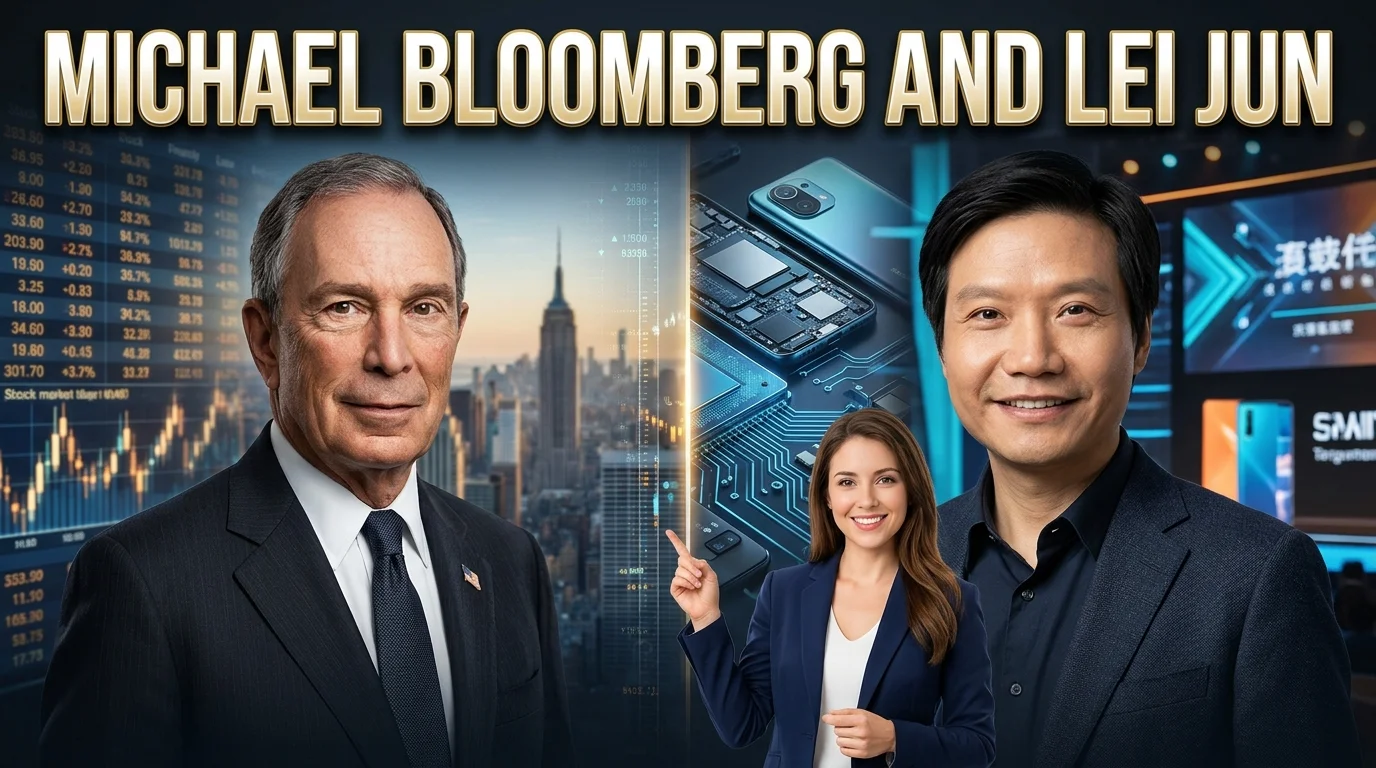
The business world is shaped by individuals who recognize opportunities, take calculated risks, and turn ambitious ideas into successful companies. Michael Bloomberg and Lei Jun are two entrepreneurs whose professional journeys demonstrate how technology, determination, and strategic leadership can influence entire industries. Although they come from different countries and have built businesses in different markets, both have established international reputations through innovation and entrepreneurship.
Michael Bloomberg is an American businessman, philanthropist, and former politician. He is best known for founding Bloomberg L.P., a global financial information and media company that provides professional tools, market data, and business news. His success demonstrates how identifying a problem in an established industry can create an opportunity for an entirely new business.
Lei Jun is a Chinese entrepreneur and technology executive who co-founded Xiaomi in 2010. He helped transform the company from a smartphone startup into an international technology brand offering smartphones, smart-home products, wearable devices, and electric vehicles. His career highlights the importance of understanding customers, developing useful products, and making technology accessible.
The keyword Michael Bloomberg and Lei Jun brings together two influential business leaders whose achievements offer valuable lessons about leadership, innovation, and long-term business development. Their stories are not based on a confirmed business partnership. Instead, comparing their professional experiences helps explain how different entrepreneurial strategies can produce success in the modern global economy.
From Bloomberg’s financial technology innovations to Lei Jun’s consumer electronics achievements, both leaders demonstrate that successful businesses begin with a clear understanding of customer needs. Their biographies, company histories, leadership approaches, challenges, and achievements provide an interesting perspective on the changing relationship between business and technology.
Quick Answer: Who Are Michael Bloomberg and Lei Jun?
Michael Bloomberg is an American entrepreneur who founded Bloomberg L.P. in 1981. His company specializes in financial information, analytics, business news, and technology services. He also served as the mayor of New York City from 2002 to 2013 and became known for his philanthropic contributions.
Lei Jun is a Chinese entrepreneur who co-founded Xiaomi in 2010. He is recognized for developing the company into a major consumer technology business. Xiaomi produces smartphones, electronic accessories, smart-home equipment, and electric vehicles.
Both entrepreneurs have used technology to identify market opportunities and establish internationally recognized businesses. However, Bloomberg primarily serves financial professionals and institutions, while Lei Jun focuses on consumer technology and connected products.
1. Michael Bloomberg Biography and Early Life
Michael Rubens Bloomberg was born on February 14, 1942, in Boston, Massachusetts, United States. He grew up in Medford, Massachusetts, in a family that valued education, discipline, and hard work. His early experiences helped develop the practical mindset that later influenced his business and political careers.
Bloomberg attended Johns Hopkins University, where he studied electrical engineering. His interest in technology provided a foundation for understanding how computer systems could improve business operations. Although he eventually became famous for his financial information company, his technical education played an important role in shaping his professional thinking.
After completing his undergraduate degree, Bloomberg continued his education at Harvard Business School. He earned a Master of Business Administration degree, developing knowledge of finance, management, economics, and organizational leadership.
In 1966, Bloomberg began working at Salomon Brothers, an investment banking firm on Wall Street. He started in an entry-level position and gradually accepted greater responsibilities. His work involved sales, trading, and information systems.
This experience introduced him to the challenges financial professionals faced when collecting and analyzing market information. Investors needed accurate data, but existing systems were often inconvenient and fragmented.
Bloomberg recognized that technology could make financial information easier to access. He began understanding how computers could improve the speed and organization of financial services.
In 1981, after leaving Salomon Brothers, he received a financial settlement and decided to establish his own company. Rather than viewing the end of his employment as a setback, he treated it as an opportunity to develop a new business.
His early life and educational experiences demonstrate how technical knowledge, business education, and professional experience can combine to create entrepreneurial opportunities.
2. Michael Bloomberg Business Career and the Founding of Bloomberg L.P.
The Michael Bloomberg business career changed significantly in 1981 when he founded Bloomberg L.P. His original goal was to improve how financial professionals accessed market information.
At the time, investment professionals needed information about stock prices, company performance, financial markets, and economic developments. Gathering these details from separate sources could take considerable time.
Bloomberg believed that a centralized computer-based system could make the process more efficient. He developed a financial information platform that eventually became known as the Bloomberg Terminal.
The terminal combined market data, financial analysis, communication features, and other professional services. It allowed customers to access important information through one system.
This innovation became the foundation of Bloomberg L.P.’s business model. Financial institutions, investment firms, banks, and other organizations recognized the value of having reliable information available through a dedicated platform.
The company’s business strategy focused on providing a service that customers needed regularly. Instead of selling a product that people might purchase once, Bloomberg developed a subscription-based service that supported ongoing professional work.
As demand increased, the company expanded its technology and services. It entered financial journalism, broadcasting, digital publishing, and business news.
Bloomberg News became an important part of this expansion. It provided reporting about financial markets, corporations, government policies, and international economic developments.
The company gradually developed an international presence, establishing offices and serving customers in major financial centers.
One important reason behind its success was its ability to combine technology with specialized information. Bloomberg understood that financial professionals did not simply need access to data. They also needed tools to interpret that data and make informed decisions.
The growth of Bloomberg L.P. demonstrates how identifying a specific customer problem can lead to the development of a valuable international business.
3. Michael Bloomberg’s Business Strategy and Revenue Model
Michael Bloomberg’s business strategy centered on creating professional value through information and technology. His company did not depend entirely on general advertising or traditional media. It developed specialized products that financial institutions and professionals were willing to pay to use.
The Bloomberg Terminal became the central part of this strategy.
Its subscription-based revenue model helped the company develop long-term relationships with customers. Financial professionals use specialized information throughout their working days, making reliable access an important business requirement.
Bloomberg also understood the importance of integrating different services. Customers could use the company’s tools to monitor financial markets, study securities, read business news, and communicate with other professionals.
This integration helped establish the terminal as part of many financial organizations’ everyday operations.
Another important element of the company’s strategy was diversification.
Bloomberg expanded into:
- Financial market data and analytics.
- Business and economic journalism.
- Television and broadcasting.
- Digital financial publications.
- Professional communication services.
- Research and information technology.
This diversification strengthened the company’s position in the broader financial information industry.
Bloomberg’s strategy also demonstrates the value of specialization. Rather than trying to compete in every technology market, the company concentrated on serving customers who required detailed financial information.
Its continued development shows how a business can maintain its relevance by improving an established product while responding to changing customer expectations.
4. Michael Bloomberg Leadership Style and Achievements
Michael Bloomberg’s leadership style is associated with data-driven decisions, measurable performance, accountability, and innovation.
His experience in financial services influenced his belief that organizations should use reliable information when making important decisions.
He also emphasized practical results. In his business and public service careers, Bloomberg often supported approaches that evaluated progress through measurable outcomes.
Several important characteristics define his leadership philosophy.
Data-driven decision-making: Bloomberg recognizes the importance of using information and evidence when evaluating opportunities and challenges.
Performance and accountability: His management approach emphasizes responsibility and evaluating whether organizations achieve their objectives.
Innovation: He built a business around a technology-based solution and continued expanding its services as customer requirements changed.
Long-term thinking: Developing Bloomberg L.P. required investment in employees, technology, customer relationships, and international operations.
Practical problem-solving: His business philosophy focuses on identifying problems and creating services that provide useful solutions.
Michael Bloomberg’s achievements extend beyond his company. His political career and philanthropic activities have also influenced his public reputation.
However, his leadership approach has attracted criticism in certain areas, particularly regarding some public policies introduced during his time as mayor. This demonstrates that influential leaders can achieve significant results while also facing disagreements and public scrutiny.
His career offers an example of how leadership requires balancing innovation, performance, responsibility, and the expectations of different groups.
5. Michael Bloomberg’s Political Career and Public Service
Michael Bloomberg entered politics after establishing himself as a successful entrepreneur. He became the mayor of New York City in 2002 and served three consecutive terms until 2013.
His first term began during a difficult period for the city. New York was still dealing with the economic and social effects of the September 11, 2001, terrorist attacks.
The city needed to strengthen its economy, restore confidence, improve public services, and support the rebuilding process.
Bloomberg’s administration concentrated on several major areas.
Economic Development
Economic recovery was an important priority. His administration worked to encourage investment, support business development, and strengthen New York City’s position as an international economic center.
Education
Bloomberg supported changes to the city’s public school system. His administration emphasized accountability, school performance, and management reforms.
Public Health
Public health became another major focus. His administration introduced policies related to smoking restrictions and healthier environments.
These initiatives generated considerable discussion about the appropriate role of government in personal and public health decisions.
Environmental Protection
Bloomberg also supported environmental programs designed to improve air quality, promote sustainability, and address urban environmental challenges.
Public Safety
Public safety remained an important part of his administration. However, his support for stop-and-frisk policing became highly controversial and attracted legal and public criticism.
His political career demonstrates that managing a major city requires different skills from managing a private company. Public officials must consider constitutional rights, social needs, government responsibilities, and the effects of policies on diverse communities.
Bloomberg’s three mayoral terms remain an important part of his overall professional biography.
6. Michael Bloomberg’s Philanthropy and Global Influence
Michael Bloomberg’s influence extends beyond financial technology and politics. Philanthropy has become an important part of his professional legacy, particularly through Bloomberg Philanthropies.
His philanthropic organization supports initiatives in public health, education, environmental protection, government innovation, and the arts.
Public Health Initiatives
Public health is one of Bloomberg’s major philanthropic priorities. He has supported international programs designed to reduce tobacco consumption, improve health policies, and strengthen public health systems.
His contributions have helped organizations develop programs addressing preventable diseases and other health challenges.
Education and Research
Bloomberg has maintained a strong connection with Johns Hopkins University. His financial contributions have supported education, research, and public health development.
He understands that educational institutions can create opportunities for future professionals while helping societies address complicated problems.
Environmental Protection
Environmental sustainability is another important part of his philanthropic work. Bloomberg has supported initiatives that encourage cities and governments to address climate change and improve environmental conditions.
Government Innovation
His philanthropic activities also support improvements in public administration. These initiatives encourage governments to use information, technology, and effective management practices when delivering public services.
The scale of his philanthropic activities demonstrates how successful entrepreneurs can use their resources to support projects outside their original industries.
His influence therefore includes business development, political leadership, education, public health, and environmental initiatives.
7. Lei Jun Biography and Early Life
Lei Jun was born in December 1969 in China. From an early age, he developed an interest in computers and technology, eventually choosing computer science as his academic field.
He attended Wuhan University and graduated with a bachelor’s degree in computer science in July 1991.
His university education provided the technical knowledge needed to understand software development, programming, and computer systems.
After graduation, Lei Jun entered the technology industry. In 1992, he joined Kingsoft Corporation, a Chinese software company.
His early professional responsibilities helped him develop experience in software development and business management. Over time, he accepted senior leadership positions and became an influential figure in the company’s development.
In 2000, he founded Joyo.com, an online retail platform. The company eventually attracted the attention of Amazon and was acquired by the American technology company in 2004.
This achievement gave Lei Jun valuable experience in online commerce and digital business models.
He also became involved in angel investing, supporting different technology-related companies. These investments allowed him to understand emerging markets and evaluate new business opportunities.
His early career demonstrates that entrepreneurship often develops through a combination of education, professional experience, experimentation, and calculated risks.
These experiences prepared him to co-found Xiaomi in 2010, which became the most recognizable part of his professional identity.
8. Lei Jun Business Career and the Founding of Xiaomi
The Lei Jun business career reached an important turning point on April 6, 2010, when Xiaomi was founded.
Lei Jun established the company with several experienced technology professionals who shared an interest in developing accessible and innovative products.
At the time, the smartphone industry was highly competitive. Established manufacturers already had strong brands, manufacturing systems, and international distribution networks.
However, Lei Jun identified an opportunity to develop smartphones that offered attractive features at competitive prices.
Xiaomi initially focused on software development and smartphones. Its early strategy emphasized product quality, user experience, and customer feedback.
One of its important developments was MIUI, an Android-based software interface designed to provide users with a customized mobile experience.
The company encouraged customer participation and paid attention to feedback when improving its software.
This approach helped Xiaomi develop a community of users who discussed product features, reported problems, and shared suggestions.
As the company grew, it expanded its hardware business and introduced smartphones designed for different customer groups.
Xiaomi gradually became recognized for offering products that combined modern designs, useful specifications, and competitive prices.
In July 2018, Xiaomi became a publicly listed company on the Hong Kong Stock Exchange.
This milestone marked an important stage in its development because it strengthened its position as an international technology business.
Today, Xiaomi’s broader business includes smartphones, smart hardware, electric vehicles, and an Internet of Things ecosystem.
Its mission emphasizes developing innovative products with honest prices so that more people can enjoy modern technology.
9. Lei Jun’s Leadership Style and Business Philosophy
Lei Jun’s leadership style is closely connected to product innovation, customer satisfaction, technology development, and teamwork.
He believes that successful technology products should provide meaningful value to consumers.
His approach is particularly interesting because Xiaomi operates in markets where customers have many choices. To remain competitive, the company must understand consumer preferences and continuously improve its products.
Customer-Centered Product Development
One important part of Lei Jun’s business philosophy is understanding customers.
Consumers do not purchase electronic devices simply because they contain advanced technology. They also consider price, design, reliability, convenience, and performance.
Xiaomi’s product strategy reflects these considerations.
Innovation and Research
Technology companies must invest in research and development to remain competitive.
Lei Jun has supported the expansion of Xiaomi’s engineering capabilities, product development, and manufacturing operations.
This investment allows the company to explore new product categories and respond to changing technology trends.
Teamwork and Management
Lei Jun’s success also reflects the importance of building a capable team.
Xiaomi was established with several experienced professionals who contributed knowledge in engineering, software, management, and business development.
Working with talented individuals allowed the company to develop products and services across different technology categories.
Long-Term Business Development
Lei Jun’s approach also emphasizes building a wider technology ecosystem instead of depending on one product.
Smartphones remain central to Xiaomi’s business, but connected devices and electric vehicles create additional opportunities.
This strategy demonstrates how a technology company can develop multiple sources of customer value.
10. Lei Jun’s Net Worth and Business Success
Lei Jun’s net worth is frequently discussed because of his position in the technology industry and his connection with Xiaomi.
His financial success is closely associated with his ownership interests in the company and its development into an international consumer technology brand.
However, personal wealth estimates can change over time because of share prices, company valuations, investments, and other financial factors.
It is therefore important to distinguish between estimated personal wealth and the total market value of a company.
Lei Jun’s business success is not limited to financial achievements.
His professional journey includes several important milestones:
- Building experience at Kingsoft.
- Founding Joyo.com.
- Supporting emerging technology companies through investments.
- Co-founding Xiaomi.
- Developing an international smartphone business.
- Expanding into connected consumer electronics.
- Leading Xiaomi’s entry into the electric vehicle industry.
These accomplishments demonstrate how technical knowledge and business experience can create opportunities in competitive industries.
11. Xiaomi’s Global Expansion and Technology Innovation
Xiaomi’s international expansion is one of the most important parts of Lei Jun’s business journey.
The company gradually moved beyond China and entered markets across Asia, Europe, and other regions.
Its competitive pricing strategy helped it attract consumers who wanted modern smartphones without necessarily purchasing the most expensive devices.
However, Xiaomi’s global growth was not based on pricing alone. The company also invested in product design, software, engineering, manufacturing, and distribution.
Another important part of its strategy is the development of connected products.
Instead of focusing only on smartphones, Xiaomi created an ecosystem involving multiple electronic devices.
Its product categories include:
Smartphones: Xiaomi smartphones remain central to its consumer technology business. The company offers devices across different price categories.
Wearable technology: Smart bands and other wearable products allow customers to monitor activities and connect with their smartphones.
Smart televisions: Xiaomi develops entertainment products that connect with its wider technology ecosystem.
Smart-home products: Compatible household devices can be controlled through connected software and applications.
Electronic accessories: The company also offers products that support everyday digital activities.
Electric vehicles: Xiaomi has entered the automotive industry, combining technology, software, design, and manufacturing.
This expansion demonstrates Lei Jun’s interest in developing businesses that connect different areas of modern technology.
However, each new market introduces additional challenges. Smartphone manufacturing and automobile production require different technical expertise, investment levels, safety requirements, and supply chains.
Xiaomi’s long-term success will depend on how effectively it manages these different business areas while maintaining product quality and customer confidence.
12. Xiaomi’s Electric Vehicle Business and Future Opportunities
One of the most interesting developments in Lei Jun’s business career is Xiaomi’s expansion into electric vehicles.
The automotive industry has changed significantly as manufacturers explore electric powertrains, advanced software, digital interfaces, and connected vehicle technologies.
Lei Jun recognized that these developments created opportunities for technology companies with experience in hardware and software.
Xiaomi entered the electric vehicle market with the ambition of combining its existing technology knowledge with automotive engineering.
Its first production electric vehicle, the Xiaomi SU7, represented a major step beyond the company’s traditional consumer electronics business.
The move also demonstrated that Xiaomi wanted to become more than a smartphone manufacturer.
Electric vehicles create opportunities to connect different technologies, including:
- Digital vehicle interfaces.
- Smart connectivity.
- Driver assistance systems.
- Battery management.
- Vehicle software.
- Connected mobile applications.
However, the automotive market is considerably more complicated than the smartphone industry.
Vehicle manufacturers must meet strict safety requirements, manage large supply chains, maintain manufacturing quality, and develop reliable after-sales services.
They also face competition from established automakers and other electric vehicle manufacturers.
Lei Jun’s decision to enter this market demonstrates his willingness to take calculated risks and explore new business opportunities.
It also illustrates why diversification must be supported by technical expertise, financial planning, and long-term investment.
13. Michael Bloomberg and Lei Jun: A Detailed Business Comparison
Michael Bloomberg and Lei Jun developed their companies in different industries, but their professional journeys share several important characteristics.
Both recognized market opportunities and developed businesses around customer needs.
Bloomberg focused on financial information and professional technology. Lei Jun concentrated on consumer electronics, software, and connected products.
Their business strategies can be compared through several categories.
| Category | Michael Bloomberg | Lei Jun |
| Nationality | American | Chinese |
| Birth year | 1942 | 1969 |
| Education | Electrical engineering and MBA | Computer science |
| Major company | Bloomberg L.P. | Xiaomi |
| Company founded | 1981 | 2010 |
| Main industry | Financial information and media | Consumer technology |
| Main product focus | Financial data and analytics | Smartphones and electronics |
| Business customers | Financial institutions and professionals | Consumers and technology users |
| Additional activities | Politics and philanthropy | Technology investments |
| Major expansion | Media and financial services | Smart devices and electric vehicles |
Their Different Approaches to Technology
Bloomberg used technology to make professional information more accessible.
His company developed a system that brought financial data, analytical tools, and communication features together.
Lei Jun used technology to develop products that consumers could use in their everyday lives.
Xiaomi combined hardware, software, and connected services to create a wider digital ecosystem.
Their Different Customer Groups
Bloomberg’s customers primarily include financial professionals, investors, banks, corporations, and institutions.
Xiaomi serves a broader consumer market, including smartphone users, households, and customers interested in connected electronics.
Their Different Revenue Strategies
Bloomberg L.P. developed a strong subscription-based business model around professional financial information and services.
Xiaomi built a business involving hardware sales, consumer products, internet services, and connected technology.
These differences show that successful businesses can follow very different paths while still applying similar principles of customer understanding and innovation.
14. Similarities Between Michael Bloomberg and Lei Jun
Although their industries are different, Michael Bloomberg and Lei Jun share several characteristics that help explain their entrepreneurial success.
1. Recognizing Market Opportunities
Bloomberg noticed that financial professionals needed better access to information.
Lei Jun recognized that consumers wanted useful technology products at competitive prices.
Both entrepreneurs identified opportunities that were connected to real customer requirements.
2. Using Technology to Create Value
Technology became the foundation of their businesses.
Bloomberg L.P. uses financial information systems and analytics, while Xiaomi develops connected electronic devices and software.
3. Building International Businesses
Both companies expanded beyond their original markets.
Bloomberg established an international financial information network, while Xiaomi developed a presence in numerous consumer technology markets.
4. Understanding Customer Needs
Both leaders recognized that business success depends on providing something valuable.
Financial professionals need accurate information, while consumers need reliable and useful products.
5. Adapting to Industry Changes
Bloomberg expanded into financial media and additional information services.
Lei Jun expanded Xiaomi beyond smartphones into smart-home devices and electric vehicles.
6. Developing Recognizable Brands
Their companies developed strong identities within their respective industries.
Bloomberg became associated with financial information and professional services.
Xiaomi became associated with consumer electronics, competitive pricing, and connected technology.
These similarities demonstrate that entrepreneurial success often depends on recognizing customer needs and adapting business operations to changing markets.
15. Challenges Faced by Michael Bloomberg and Lei Jun
Successful entrepreneurs rarely build influential companies without facing serious challenges.
Michael Bloomberg and Lei Jun both experienced uncertainty, competition, and difficult business decisions during their professional journeys.
Challenges in Michael Bloomberg’s Business Career
Bloomberg faced uncertainty when he left Salomon Brothers in 1981.
Starting a new financial technology company required convincing established institutions that his services could provide genuine value.
He also needed to invest in technology and build a team capable of delivering reliable information.
Another challenge involved maintaining customer confidence.
Financial professionals depend on accurate and timely information. Technical problems or unreliable data could damage the reputation of a financial information provider.
Competition from other financial data companies also required continuous product improvement.
His political career introduced a different set of challenges. Managing New York City involved complex economic, educational, environmental, and public safety issues.
Challenges in Lei Jun’s Business Career
Lei Jun entered the smartphone market when established companies already had significant advantages.
Xiaomi needed to develop competitive products while building brand recognition and distribution networks.
International expansion created additional difficulties because different countries have different consumer preferences, regulations, and business conditions.
Manufacturing also presented challenges. Producing electronic devices at scale requires careful management of components, quality control, logistics, and suppliers.
The company’s expansion into electric vehicles introduced even greater complexity.
Automotive manufacturing requires substantial capital, specialized engineering, safety testing, and long-term customer support.
These experiences show that successful entrepreneurship requires more than a good idea. It also requires the ability to manage risk, respond to competition, and improve business operations.
16. What Entrepreneurs Can Learn From Michael Bloomberg and Lei Jun
The careers of Michael Bloomberg and Lei Jun offer useful lessons for people who want to start or develop their own businesses.
Understand a Real Problem
A business idea becomes more valuable when it solves a problem that customers genuinely experience.
Bloomberg recognized the difficulties of accessing financial information. Lei Jun identified the demand for accessible consumer technology.
Use Your Professional Experience
Both entrepreneurs built on their previous knowledge.
Bloomberg used his Wall Street experience to establish a financial information business.
Lei Jun used his software and management experience to develop a technology company.
Focus on Customer Value
Businesses should offer products and services that customers find useful.
Understanding customer expectations helps companies develop better products and improve their reputation.
Invest in Innovation
Markets change as technology develops.
Companies that continue improving their services are better prepared to respond to competition.
Build a Strong Team
Large businesses require people with different skills and professional experiences.
Strong teams help organizations solve problems and manage growth.
Think Beyond Immediate Results
Both entrepreneurs spent years developing their companies.
Their experiences show that long-term success requires patience, planning, and consistent investment.
Adapt to New Opportunities
Bloomberg expanded into media and philanthropy, while Lei Jun moved Xiaomi into new technology categories.
Their careers demonstrate the importance of remaining open to opportunities while evaluating risks carefully.
17. Are Michael Bloomberg and Lei Jun Business Partners?
A common question surrounding the keyword Michael Bloomberg and Lei Jun is whether the two entrepreneurs have a direct business relationship.
Both individuals have made important contributions to technology-related industries, but this does not automatically establish a professional partnership.
Michael Bloomberg founded Bloomberg L.P., a company specializing in financial information, analytics, and business media.
Lei Jun co-founded Xiaomi, a company focused on smartphones, consumer electronics, smart devices, and electric vehicles.
Their businesses operate in different primary markets and serve different customer groups.
There is no established evidence in the information discussed here confirming that they are direct business partners or have completed a specific joint project.
Therefore, their relationship is best understood as a professional comparison between two influential entrepreneurs.
Their individual careers provide enough interesting material to explore without suggesting an unsupported business connection.
18. Why Michael Bloomberg and Lei Jun Remain Influential Business Leaders
Michael Bloomberg and Lei Jun remain important examples of modern entrepreneurship because they demonstrate how technology can transform different industries.
Bloomberg helped change the way financial professionals access information. His company’s services became important tools for people working in financial markets and business organizations.
Lei Jun helped develop Xiaomi into a major consumer technology brand. His company expanded access to smartphones and connected electronic products while exploring opportunities in electric vehicles.
Their influence also demonstrates that entrepreneurship is not limited to one industry or business model.
A successful entrepreneur might build a company around specialized professional information, while another might develop products for millions of everyday consumers.
Both approaches require customer understanding, investment, leadership, and the ability to respond to changing market conditions.
Their professional journeys also provide inspiration for students, technology enthusiasts, and future business owners.
People interested in finance can learn from Bloomberg’s focus on information and professional services.
People interested in consumer technology can learn from Lei Jun’s approach to product development, software, and accessible innovation.
Ultimately, their influence comes from the businesses they developed and the lasting contributions they made to their respective industries.
19. Frequently Asked Questions (FAQs)
1. Who Is Michael Bloomberg?
Michael Bloomberg is an American businessman, philanthropist, and former politician. He founded Bloomberg L.P. in 1981 and served as the mayor of New York City from 2002 to 2013. He is widely recognized for his contributions to financial technology, business media, and public service.
2. Who Is Lei Jun?
Lei Jun is a Chinese entrepreneur and technology executive. He co-founded Xiaomi in 2010 and helped develop it into an international consumer technology company. He is known for his contributions to smartphones, connected devices, and electric vehicles.
3. What Companies Did Michael Bloomberg and Lei Jun Found?
Michael Bloomberg founded Bloomberg L.P., which specializes in financial information, analytics, and media services. Lei Jun co-founded Xiaomi, which develops smartphones, consumer electronics, smart-home products, and electric vehicles.
4. Are Michael Bloomberg and Lei Jun Business Partners?
There is no established evidence confirming that Michael Bloomberg and Lei Jun are direct business partners. They are separate entrepreneurs whose professional achievements can be compared because of their contributions to technology and business.
5. What Is Michael Bloomberg Famous For?
Michael Bloomberg is famous for founding Bloomberg L.P., developing financial information technology, serving as New York City’s mayor, and supporting philanthropic initiatives involving education, health, and environmental protection.
6. What Is Lei Jun Famous For?
Lei Jun is famous for co-founding Xiaomi and helping transform it into a major international technology company. He is also recognized for expanding the company’s operations into smart-home technology and electric vehicles.
7. What Is the Difference Between Bloomberg L.P. and Xiaomi?
Bloomberg L.P. primarily provides financial information, market analytics, professional communication tools, and business news. Xiaomi focuses on consumer electronics, smartphones, smart-home products, and connected technology.
8. What Can Entrepreneurs Learn From Michael Bloomberg and Lei Jun?
Entrepreneurs can learn the importance of identifying market opportunities, understanding customers, investing in innovation, building capable teams, and developing long-term business strategies.
9. How Did Lei Jun Become Successful?
Lei Jun developed his career through software development, business management, and technology investments. His experience at Kingsoft and the founding of Joyo.com helped prepare him to establish Xiaomi in 2010.
10. How Did Michael Bloomberg Build His Wealth?
Michael Bloomberg built his wealth primarily through Bloomberg L.P. The company’s financial information services, technology products, and professional subscriptions helped it become an influential international business.
Conclusion
Michael Bloomberg and Lei Jun represent two different approaches to entrepreneurship, innovation, and business leadership. Michael Bloomberg transformed financial information services through Bloomberg L.P., while Lei Jun helped establish Xiaomi as a major international consumer technology company. Their biographies demonstrate how education, professional experience, strategic thinking, and customer understanding can create valuable business opportunities.
Although their industries and leadership approaches differ, both entrepreneurs recognize the importance of technology and continuous improvement. Their achievements also offer important lessons about managing competition, building strong organizations, and adapting to changing markets. Ultimately, the stories of Michael Bloomberg and Lei Jun demonstrate that successful entrepreneurship requires more than ambition. It requires practical ideas, consistent effort, and the ability to turn opportunities into lasting business achievements.

Amelia Brooks is a passionate language writer and word enthusiast at Meanzafy.com. I love exploring the meanings of words, text abbreviations, slang, and everyday English expressions to make language simple and easy for everyone. My goal is to create clear, accurate, and engaging content that helps readers quickly understand confusing words and phrases with confidence. Whether you’re looking for text meanings, grammar tips, or language guides, I’m here to make learning English enjoyable and practical.