You’re mid-conversation with someone, replying back and forth, when suddenly they text “hry?” and nothing else. No context, no follow-up, just those three letters sitting there. You blink at your screen for a second, wondering if it’s a typo or something you’re supposed to already know.
If that’s how you ended up here, don’t worry this happens to almost everyone at some point. Texting slang shifts and spreads so quickly that it’s genuinely hard to keep up, especially when new abbreviations pop up in group chats or social media comments seemingly overnight.
This article is here to clear things up completely. We’re breaking down everything about HRY meaning in text what it stands for, where people actually use it, how it came about, and how to respond the next time it shows up in your messages. By the end, you’ll never have to second-guess it again.
What Does “HRY” Mean in Texting?
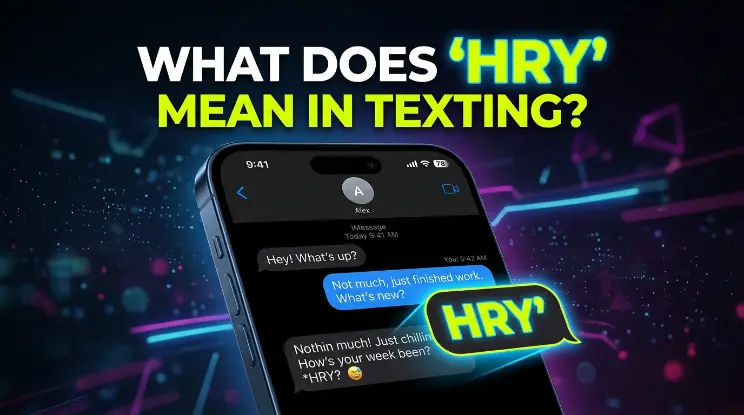
In most casual texting contexts, HRY stands for “How Are You?” a simple, shorthand way of checking in on someone, usually used to open or continue a casual conversation.
It works exactly like the full phrase “how are you,” just compressed down for faster typing. If someone texts “hry? haven’t talked in a while,” they’re simply asking how you’re doing, often after some time apart or as a casual conversation starter.
There’s nothing complicated behind it HRY meaning in text is really just a quick, friendly way of asking about someone’s wellbeing or current situation without typing out the full question every time.
Full Form / Expansion of “HRY”

The most common full form of HRY breaks down as:
H – How
R – aRe (the “r” represents “are”)
Y – You
Put together: “How Are You?”
This follows the same shorthand logic used in other common abbreviations, where vowels get dropped and letters are chosen based on sound rather than strict spelling similar to how “are” becomes just “r” in texts like “r u ok?”
Occasionally, people use slightly different intended phrasing behind the same letters, such as:
- “How’re you?”
- “How you doing?” (looser interpretation)
But the core meaning across all variations stays the same it’s a casual check-in question.
Where “HRY” is Commonly Used
HRY shows up across several different online spaces, generally carrying the same warm, casual tone wherever it appears.
Gaming Chats
In multiplayer games like Fortnite or Call of Duty, players sometimes type quick check-ins between matches. A message like “hry? been a while since we squaded up” is a pretty typical example.
Social Media (Instagram, TikTok, Snapchat)
HRY meaning in text shows up often in Instagram and Snapchat DMs, especially when someone reconnects with a friend after a bit of a gap. On TikTok, it sometimes appears in comment replies where users are catching up casually.
Group Chats
In friend or family group chats, HRY is a natural way to check in on everyone, especially after a period of inactivity. “Hey guys, hry? been quiet in here” is a common type of message.
Forums and Comment Sections
On platforms like Reddit, HRY occasionally pops up in casual or community threads, especially when users are chatting informally rather than discussing serious topics.
Live Streams
During Twitch or YouTube Live chats, viewers sometimes type “hry?” to the streamer or fellow chat members as a quick, friendly check-in amid the fast-moving conversation.
Origin & History of “HRY” as a Texting Abbreviation
Like most texting abbreviations, HRY doesn’t have one clear inventor or exact starting point. It developed naturally out of the broader trend of shortening frequently used phrases to save time while typing a habit that became especially common during the early SMS era, when character limits and slow keypads made every letter count.
“How are you?” is one of the most universally used phrases in everyday conversation, so it makes sense that it eventually got condensed the same way other common phrases did, following a pattern similar to abbreviations like “hbu” (how about you) and “hru” (how are you), which HRY closely resembles.
As texting evolved into instant messaging and then into social media DMs, abbreviations like HRY carried over naturally into those spaces too. Once younger generations shifted much of their daily communication to apps like Snapchat, Instagram, and Discord, existing texting shorthand simply moved along with them.
There’s no confirmed “first use” moment for HRY specifically, but its steady, low-key popularity mirrors dozens of similar abbreviations that exist purely to make typing faster and conversations smoother.
Other Possible Meanings of “HRY”
While “how are you?” is by far the most common HRY meaning in text, there are a couple of alternate interpretations that occasionally show up depending on context:
- “Hurry” – Sometimes typed as a quick, informal way of telling someone to speed up. Example: “hry up, we’re gonna be late.”
- “Hungry” – Occasionally used as an abbreviated way to say someone’s hungry, especially in fast, informal typing. Example: “so hry rn, let’s eat.”
These alternate meanings are far less common than the primary “how are you” usage, but they’re worth knowing so context clues don’t throw you off if the conversation doesn’t quite match the usual definition.
How to Use “HRY” Correctly
Using HRY naturally comes down to reading the tone of the conversation. Here’s how to get it right:
- Keep it casual. HRY is meant for relaxed, informal chats not something you’d send to a teacher, boss, or client.
- Use it as a check-in opener. It works well at the start of a conversation, especially after some time apart, or as a simple, low-effort way to ask how someone’s doing.
- Match the conversation’s tone. If the chat already has abbreviations like “hbu,” “wyd,” or “lol” in it, HRY fits right in naturally.
- Don’t worry about strict punctuation. Lowercase is standard, and a question mark is optional depending on personal texting style.
- Pair it with a friendly emoji if you want. Something like “hry? 😊” softens the tone and adds warmth.
Example Conversations Using “HRY”
Here are several real-style chat snippets showing how HRY meaning in text plays out across different platforms.
1. Texting a Friend
Person A: “hry? haven’t heard from you in a bit”
Person B: “I’m good! just been busy with work”
2. WhatsApp Chat
Person A: “hry? hope everything’s okay”
Person B: “Doing fine, just a rough week”
3. Instagram DM
Person A: “saw your story, hry?”
Person B: “I’m good, just traveling rn”
4. TikTok Comment Section
Comment 1: “haven’t seen you post in a while, hry?”
Reply: “aww thank you, doing well!”
5. Gaming Chat
Player A: “hry? it’s been a minute since we played”
Player B: “good man, just been busy with school”
6. Group Chat
Person A: “hry everyone? feels quiet in here lately”
Person B: “all good here, just busy”
7. Snapchat Reply
Person A: “hry? missed talking to you”
Person B: “I’m okay! missed this too”
8. Live Stream Chat
Viewer: “hry today? seem a bit quiet”
Streamer: “just a long day lol but I’m good”
9. Casual Caring Text
Person A: “hry? heard you weren’t feeling well”
Person B: “a bit better today, thanks for checking”
10. Discord Server
User A: “hry? haven’t seen you online lately”
User B: “been swamped with work, but I’m good”
When NOT to Use “HRY”
HRY is strictly casual, so there are definitely situations where it should be avoided:
- Professional emails – Always spell out full, proper sentences in workplace communication.
- Job interviews or recruiter chats – Even over messaging platforms, keep the tone formal and polished.
- Formal texts to teachers, professors, or bosses – Stick to complete words and proper grammar.
- Customer service conversations – Whether you’re a customer or representative, abbreviations like HRY can come across as unprofessional.
- Serious or sensitive conversations – If someone’s going through something difficult, typing out the full “how are you?” often feels more genuine and caring than the shorthand version.
If the setting wouldn’t allow for casual slang like “lol” or “omg,” it’s best to skip HRY too.
Similar Texting Abbreviations and How “HRY” is Different From Them
A few abbreviations serve a similar purpose to HRY, though each carries a slightly different nuance.
- HRU (How Are You) – Nearly identical in meaning and function; HRU is arguably the more widely recognized version of this exact phrase.
- HBU (How About You) – Typically used as a follow-up question after sharing something, rather than as an opening check-in like HRY often is.
- WYD (What You Doing) – Focuses specifically on current activity, while HRY is more about general wellbeing or mood.
- SUP (What’s Up) – A more general, energetic greeting, often used to start a conversation casually rather than check in on someone’s wellbeing specifically.
- WGY (What’s Good, You) – Similar casual energy, but leans more toward “what’s going on” rather than directly asking about someone’s state of being.
The main distinction with HRY is that it leans slightly more caring or sincere in tone compared to something like WGY or SUP it’s often used when someone genuinely wants to know how another person is doing, not just what they’re up to.
How to Respond When Someone Sends You “HRY”
Responding to HRY is simple just share how you’re actually doing, whether that’s your mood, your day, or your general situation. A few solid response styles:
- Straightforward: “I’m good, just a bit tired.”
- Detailed: “Doing okay, work’s been busy but nothing confused.”
- Casual and short: “I’m good, hry?”
- Honest: “Not gonna lie, it’s been a rough day.”
Since HRY often comes from a place of genuine care, it’s worth giving a real answer rather than a one-word brush-off, especially if the person asking is a close friend or family member.
Common Mistakes/Misunderstandings Around “HRY”
A few things trip people up when they first encounter HRY:
- Confusing it with HRU – Because the two look and function almost identically, people sometimes mix them up or aren’t sure which is more “correct” (both are acceptable).
- Assuming it always means “hurry” or “hungry” – While these meanings exist, they’re far less common than “how are you,” so context is key.
- Using it in serious or emotional conversations – In situations where someone’s genuinely struggling, the shorthand version can come across as less caring than typing out the full question.
- Overusing it in every message – Repeating it too often in the same conversation can start to feel repetitive rather than genuine.
- Expecting everyone to recognize it instantly – HRY isn’t as universally known as HRU or “how r u,” so some people might need a second to figure it out.
FAQs
What does HRY mean in text?
HRY meaning in text is most commonly “How Are You?” a casual, shorthand way of checking in on someone.
Is HRY the same as HRU?
Yes, they’re essentially the same, though HRU (How Are You) is the more widely recognized and commonly used version.
Can HRY mean something other than “how are you”?
Yes, in some contexts it can mean “hurry” or “hungry,” though these meanings are much less common than the primary definition.
Is HRY appropriate for formal messages?
No, HRY meaning in text is strictly casual slang and should be avoided in professional or formal communication.
Where did HRY come from?
It evolved from the everyday phrase “how are you,” shortened the same way many other common texting phrases became abbreviations.
How do I respond to HRY?
Simply share how you’re actually doing your mood, your day, or a quick honest update works well.
Conclusion
So the next time “hry?” pops up in your messages, you won’t have to pause and wonder what’s going on. At its core, HRY meaning in text comes down to a simple, caring way of asking “how are you?” perfect for casual check-ins without typing out the full question every time.
You’ll mostly spot it in relaxed settings like group chats, DMs, and social media comments, sitting right alongside similar abbreviations like HRU, HBU, and WGY. Keep it casual, save the full phrase for more serious or formal conversations, and you’re all set to use and respond to HRY with confidence.

Ethan Parker
Hi, I’m Ethan Parker, a language enthusiast and content writer at Meanzafy.com. I enjoy exploring the meanings of words, slang, abbreviations, and everyday expressions to make English easier for everyone. My goal is to create clear, accurate, and beginner-friendly content that helps readers quickly understand what words and phrases really mean. Through every article, I aim to make learning English simple, practical, and enjoyable.