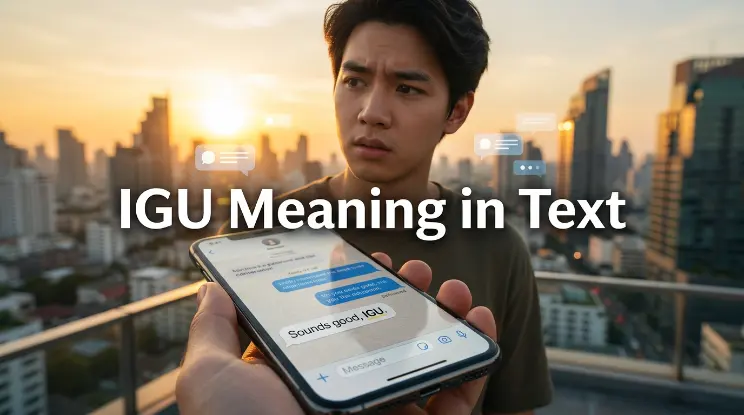
You ask a friend for help with something, or maybe you vent about a rough day, and the reply that comes back is just three letters: “IGU.” No extra explanation attached. Now you’re sitting there trying to figure out if that was reassuring or if they just gave up on helping you altogether.
If that moment of confusion sounds familiar, you’ve run into one of texting’s more genuinely split abbreviations. Unlike terms that mean pretty much the same thing no matter who sends them, IGU can swing between two almost opposite meanings depending entirely on context. That’s exactly why it trips people up so often, especially the first few times they encounter it.
This guide breaks down everything you need to know about IGU meaning in text both of its major interpretations, where it’s used, how it developed, and most importantly, how to figure out which meaning someone intends when they send it your way. By the end, you’ll be able to read IGU with confidence instead of second-guessing the tone.
What Does “IGU” Mean in Texting?
Here’s the honest, upfront answer: IGU meaning in text splits mainly between two very different phrases “I Give Up” and “I Got You.”
Yes, those two meanings are basically opposites. “I Give Up” signals frustration, defeat, or surrender, while “I Got You” signals support, reassurance, or understanding. Because both phrases happen to share the same first letters, IGU ended up representing both, and the only way to tell them apart is by paying close attention to the conversation happening around it.
In practice, most people lean toward one of these two meanings depending on their specific friend group, community, or personal texting habits. Some circles use IGU almost exclusively to mean “I got you,” treating it as a quick, supportive confirmation. Others use it mainly to express giving up on something frustrating or overwhelming. Because of this split, IGU meaning in text really does require reading the room before you respond.
Full Form / Expansion of “IGU”
Since IGU carries two genuinely different expansions, here’s a breakdown of both.
I Give Up I stands for “I,” G stands for “Give,” and U stands for “Up.” This version expresses surrender, frustration, or resignation toward a task, problem, or situation.
I Got You I stands for “I,” G stands for “Got,” and U stands for “You.” This version expresses support, reassurance, agreement, or a willingness to help.
Because both phrases naturally compress down to the same three letters, IGU exists as a rare case of a texting abbreviation with two distinct, nearly opposite full forms. This is different from most slang terms, which usually have one dominant meaning with maybe a few minor variations.
Where “IGU” is Commonly Used
IGU shows up across a range of casual digital spaces, and where you encounter it can sometimes offer clues about which meaning is intended.
Group Chats and Everyday Texting
In casual texting between friends, IGU frequently appears in response to a task, favor, or request, functioning as a quick “I got you” confirmation.
Gaming Chats
In online multiplayer games, IGU often shows up as “I give up,” especially after a particularly frustrating level, boss fight, or repeated loss.
Study Groups and Homework Help Chats
Among students, IGU commonly appears as “I give up” when someone is stuck on a difficult problem or overwhelmed by an assignment.
Social Media Comments and DMs
On platforms like Instagram and TikTok, IGU can show up either way as a supportive comment showing solidarity, or as a relatable, humorous expression of giving up on something frustrating.
Workplace or Team Messaging Apps
In more casual work chats, IGU sometimes appears as “I got you,” used to confirm that someone will handle a task or follow up on something without needing a longer reply.
Origin & History of “IGU” as a Texting Abbreviation
IGU doesn’t have one single, clean origin story, largely because it developed independently along two separate paths that happened to collide into the same three letters.
The “I give up” version of IGU has roots in gaming and online chatroom culture, where players and chatters needed a fast way to express frustration or defeat during difficult challenges. As texting became more widespread through the 2000s, this habit of shortening frustrated exclamations carried over into everyday digital conversation, especially among students and casual texters dealing with tough homework or stressful situations.
The “I got you” version developed somewhat separately, growing out of the broader trend of abbreviating supportive, reassuring phrases in fast-paced texting. Since “I got you” is such a commonly used phrase for offering help or confirming understanding, it made sense for it to eventually get compressed the same way other frequently used phrases did.
Because these two meanings emerged from different conversational contexts rather than one shared origin, IGU never settled into a single, universally agreed-upon meaning. Instead, its interpretation became heavily dependent on the specific community, friend group, or platform where it’s being used, which is exactly why context remains so essential when figuring out what someone means by it today.
Other Possible Meanings of “IGU”
Beyond the two major interpretations already covered, there are a few additional nuances worth knowing about.
1. Sarcastic “I Give Up”
Sometimes IGU as “I give up” isn’t meant literally at all, but used humorously or sarcastically to react to something mildly frustrating or funny, rather than expressing genuine defeat.
2. Casual Agreement Beyond Direct Help
The “I got you” version of IGU doesn’t always mean someone is offering literal help sometimes it’s simply used to show general agreement or understanding, similar to saying “makes sense” or “got it.”
3. Rare Confusion with Unrelated Terms
Because IGU is a less universally standardized abbreviation, it’s occasionally mistaken for unrelated phrases or acronyms by people unfamiliar with either common meaning.
Given this genuine split in meaning, paying close attention to tone and context is really the only reliable way to correctly interpret IGU meaning in text.
How to Use “IGU” Correctly
If you want to start using IGU yourself, here’s how to make sure your intended meaning comes across clearly.
Add context when using it to mean “I give up.” Since this meaning can feel more emotionally significant, pairing it with a bit of explanation, like “IGU, this problem makes no sense,” helps avoid confusion.
Use it confidently for quick reassurance. When using IGU to mean “I got you,” it works well as a fast, casual confirmation, especially with people who already understand your texting style.
Know your audience. Since IGU’s meaning depends so heavily on context and community, it’s worth considering whether the person you’re texting is likely to interpret it the way you intend.
Pair it with emojis to clarify tone. A frustrated emoji can help signal “I give up,” while a thumbs up or heart can help confirm the more supportive “I got you” meaning.
Example Conversations/Chat Snippets Using “IGU”
Here are several real-style examples showing how IGU meaning in text plays out across different platforms and situations.
Example 1 I Got You Usage Friend: “can you grab milk on your way home?” You: “IGU”
Example 2 I Give Up Usage Friend: “did you finish the puzzle?” You: “nah, IGU, it’s impossible”
3 Gaming Chat Frustration Teammate: “we lost again 💀” You: “IGU for today, taking a break”
4 Supportive Group Chat Friend: “can someone remind me about the meeting tomorrow?” You: “IGU, I’ll text you before”
5 Study Group Frustration Classmate: “this math problem makes no sense” You: “IGU too honestly, let’s ask the teacher”
6 Quick Task Confirmation Coworker: “can you send that file over?” You: “IGU, sending now”
7 TikTok Comment (I Give Up) Comment under a relatable video: “igu trying to adult today lol”
8 Instagram Comment (I Got You) Comment under a friend’s post: “igu, always here to support you 💛”
9 Sarcastic Frustration Friend: “still trying to fix my wifi” You: “IGU, just buy a new router at this point 😂”
10 Reassurance in a Tough Moment Friend: “I’m really stressed about this deadline” You: “IGU, we’ll figure it out together”
IGU Meaning in Chat, WhatsApp, Instagram, TikTok
Across different platforms, the intended IGU meaning in text often depends heavily on the type of conversation happening. On WhatsApp and everyday texting, IGU frequently leans toward “I got you,” especially in quick exchanges about tasks, favors, or plans. On TikTok, IGU often shows up in comments as “I give up,” typically used humorously to react to relatable, frustrating, or chaotic content. Instagram, both meanings show up fairly evenly, with “I got you” appearing more in supportive comments and DMs, while “I give up” tends to show up in more casual, joking captions or replies.
When NOT to Use “IGU”
While IGU fits naturally into casual digital conversations, there are certain settings where it’s better avoided.
Professional emails or workplace communication. IGU’s inherent ambiguity, combined with its casual tone, makes it unsuitable for professional settings where clear, precise language matters most.
Conversations with people unfamiliar with the term. Since IGU carries two nearly opposite meanings, using it with someone less familiar with casual texting slang could easily cause real confusion.
Serious or emotionally significant conversations. If someone is discussing something genuinely difficult or important, relying on an ambiguous abbreviation like IGU risks sending the wrong message entirely.
Situations requiring clear, unambiguous communication. Because IGU can mean two very different things, it’s not the best choice whenever precision really matters.
Similar Texting Abbreviations and How “IGU” is Different from Them
A handful of other abbreviations overlap with IGU’s two meanings, though each carries its own distinct nuance.
IDK (I Don’t Know): Expresses uncertainty rather than surrender or support, making it functionally different from either meaning of IGU.
Gotchu: A more casual, phonetic version of “I got you,” carrying the same supportive meaning as one side of IGU, but without the ambiguity.
Fml (F My Life): Expresses genuine frustration or defeat, similar to IGU’s “I give up” meaning, but generally carrying a more dramatic or exaggerated tone.
Np (No Problem): Often used as a response to thanks rather than an offer of help, making it functionally different from IGU’s “I got you” meaning, which is more proactive.
Ion (I Don’t): Unrelated in meaning, but sometimes confused with IGU due to both being short, casual abbreviations that require context to interpret correctly.
Understanding these small distinctions helps you pick the clearest, most appropriate term depending on whether you’re expressing frustration, support, or something else entirely.
How to Respond When Someone Sends You “IGU”
Not sure how to reply when someone texts you IGU? Here’s how to handle it depending on the context.
- If it seems like “I give up”: Offering encouragement with “don’t give up yet, want help?” or simply validating their frustration with “that’s so annoying, I get it” works well.
- If it seems like “I got you”: A simple “thank you!” or “appreciate it” acknowledges their support.
- If the meaning is unclear: Asking “wait, IGU as in you got it, or you’re giving up? 😅” is a totally normal and easy way to clarify.
- If it follows a request you made: Context usually makes it clear they mean “I got you,” so a quick “thanks, appreciate it!” fits naturally.
Common Mistakes/Misunderstandings Around “IGU”
Even though IGU shows up fairly often in casual texting, a few common mix-ups happen regularly, mostly because of its genuinely split meaning.
Assuming the wrong interpretation. Since IGU can mean either “I give up” or “I got you,” misreading the intended meaning can lead to a completely backwards understanding of what someone is trying to say.
Overlooking context clues. Because IGU’s meaning depends so heavily on the surrounding conversation, skipping past earlier messages can make it genuinely difficult to interpret correctly.
Assuming everyone uses it the same way. Different friend groups and communities may lean more heavily toward one meaning over the other, so what feels obvious in one circle might be confusing in another.
Not clarifying when unsure. Because the stakes of misreading IGU can be higher than with less ambiguous slang, it’s often worth simply asking for clarification rather than guessing.
FAQs About IGU Meaning in Text
What does IGU mean in a text message?
IGU most commonly means either “I Give Up” or “I Got You,” depending entirely on the context of the conversation.
Why does IGU have two different meanings?
IGU developed somewhat independently across different communities, with “I give up” growing out of gaming and frustration-driven contexts, while “I got you” developed as a shorthand for support and reassurance.
How do I know which meaning of IGU someone intends?
Pay close attention to the surrounding conversation. If it follows a difficult or frustrating topic, it likely means “I give up.” If it follows a request or favor, it likely means “I got you.”
Is IGU always negative?
No, IGU is only negative when it’s being used to mean “I give up” in a genuinely frustrated context. The “I got you” meaning is generally positive and supportive.
Can IGU be used sarcastically?
Yes, especially in its “I give up” form, IGU is often used humorously or sarcastically to react to mildly frustrating or funny situations rather than expressing real defeat.
Is it okay to use IGU casually with friends?
Yes, IGU works well in casual, informal texting, though it’s worth adding context or checking in if there’s any chance your meaning could be misread.
Conclusion
At the end of the day, IGU meaning in text is a genuinely unique case among texting abbreviations, splitting between two almost opposite phrases: “I Give Up” and “I Got You.” Because both meanings compress down to the same three letters, context really is everything when it comes to figuring out what someone means.
Whether you’re seeing it as a frustrated reaction to a tough homework problem, a quick, supportive confirmation in a group chat, or a relatable comment under a chaotic TikTok video, IGU has carved out a genuinely flexible role in casual digital communication. Now that you understand both sides of IGU meaning in text, you’ll be able to read the context and figure out exactly what someone meant, without ever mixing up a surrender for a show of support.

Amelia Brooks is a passionate language writer and word enthusiast at Meanzafy.com. I love exploring the meanings of words, text abbreviations, slang, and everyday English expressions to make language simple and easy for everyone. My goal is to create clear, accurate, and engaging content that helps readers quickly understand confusing words and phrases with confidence. Whether you’re looking for text meanings, grammar tips, or language guides, I’m here to make learning English enjoyable and practical.