You’re reading through a text, a DM, or maybe even an email, and right at the bottom, after the person already said everything they needed to say, there’s a little “PS” followed by one more line. It feels like an afterthought, but somehow it usually ends up being the most interesting part of the whole message.
“PS” is one of those texting abbreviations that’s been around way longer than texting itself, yet it still shows up constantly in modern chats, DMs, captions, and even casual notes. You’ll see it in WhatsApp messages, Instagram captions, TikTok comment threads, and group chats, usually right before someone drops a little extra detail they “almost forgot” to mention.
This guide breaks down the full PS meaning in text, where it actually comes from, how people use it today across different apps, and how you can use it yourself without it feeling forced or old-fashioned. By the end, you’ll understand exactly why this tiny two-letter add-on has survived for centuries and is still going strong in modern texting culture.
What Does “PS” Mean in Texting?
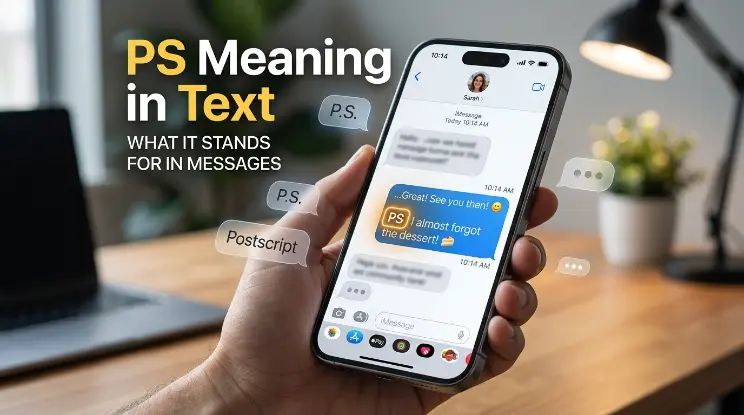
The straightforward answer is that PS stands for “postscript.” In texting and casual chat, it’s used to add a quick extra thought, detail, or comment after the main part of your message is already done. It’s basically the digital version of writing a letter, signing off, and then adding “oh wait, one more thing” right underneath.
The PS meaning in text hasn’t really changed from its original letter-writing use it’s still signaling “here’s something additional I want to mention, even though I technically already finished my point.” The tone can shift depending on what follows it, though. Sometimes it’s used for something genuinely important that got left out. Other times it’s used almost playfully, tacking on a joke, a compliment, or a little teaser after a serious message.
So when you see “PS” in a text, chat, or comment, the sender is telling you: “Wait, before you go, here’s one more thing.”
Full Form / Expansion of “PS”
Unlike a lot of internet-born acronyms, “PS” actually has a real, documented origin in written language. Here’s the breakdown:
- P = Post
- S = Scriptum
Together, this comes from the Latin phrase “post scriptum,” which literally translates to “written after.” In English, this became “postscript,” and “PS” is simply the shortened abbreviation of that word.
There’s also a related, slightly less common version you might come across: PPS, which stands for “post post scriptum,” basically meaning “a second thing written after” used when someone adds a second afterthought following their original PS. You’ll mostly see this in longer, more old-school style messages or emails rather than quick texts, but it’s worth knowing since it comes from the exact same root.
Where “PS” is Commonly Used
“PS” shows up in more places than you’d think, ranging from formal writing all the way down to casual one-line texts.
Text Messages and WhatsApp
In personal texting, “PS” usually caps off a message with one more small detail. Someone might send a longer text about weekend plans, then add “ps bring a jacket, it might get cold.”
Emails
This is actually where “PS” has stuck around the longest and most naturally. Even in professional or semi-formal emails, people use “PS” to slip in something outside the main topic, almost like a friendly, low-pressure add-on.
Social Media Captions
On Instagram and TikTok, “PS” often shows up at the end of captions to add a bonus thought, a joke, or a shoutout that doesn’t quite fit the main caption.
Comment Sections
In comment threads, people use “PS” to tack on a second point after already replying to something, almost like a mini follow-up without needing to write a whole new comment.
Group Chats
In group chats, “PS” often introduces a reminder or a small logistical detail that almost got forgotten like confirming a time, location, or last-minute change.
Letters and Notes
Even outside of digital communication, handwritten notes and letters still use “PS” the exact same way it’s always been used, which is honestly part of why it feels so natural in texting too.
Origin & History of “PS” as a Texting Abbreviation
Unlike most texting slang, which developed out of internet chat rooms or SMS character limits, “PS” has a genuinely old history. The phrase “post scriptum” dates back centuries, used in formal letter writing long before phones, computers, or the internet existed. Writers would finish their letter, sign it, and then realize they had one more thing to add rather than rewriting the entire letter, they’d simply add a line at the bottom labeled “PS.”
This became such a standard practice in formal and personal letter writing that the abbreviation eventually became more common than spelling out the full Latin phrase. By the time typewriters and then early word processors came around, “PS” was already a fully normalized part of written communication.
When texting and instant messaging exploded in the 2000s, “PS” made a smooth and natural transition into digital communication. Unlike newer internet-born acronyms that needed to be learned and explained, “PS” was already familiar to basically everyone, since most people had encountered it in emails, letters, or even school assignments. That familiarity is a big part of why it still feels timeless in casual texting today, instead of feeling like slang that needs decoding.
As social media grew, “PS” slid easily into captions and comments too, since it fits perfectly into short-form writing where people want to add one more quick thought without restructuring their whole post.
Other Possible Meanings of “PS”
While “postscript” is by far the dominant meaning, “PS” does pop up with other meanings depending on the context:
- PlayStation: In gaming conversations, “PS” is extremely commonly used as shorthand for Sony’s PlayStation console (like “PS4” or “PS5”). Context almost always makes this obvious, since it’s usually paired with a number or a game title.
- Public School: In some conversations, especially among students or parents, “PS” can refer to a public school, often followed by a number (like “PS 122”).
- Photoshop: In creative and design communities, “PS” is frequently used as shorthand for Adobe Photoshop.
- Passenger Seat: In casual texting about car rides, “PS” occasionally gets used to mean passenger seat, though this is far less common and usually spelled out to avoid confusion.
Because “PS” has so many possible meanings, context does a lot of heavy lifting. A text that says “ps did you edit that in Photoshop” clearly isn’t about postscript, while a text ending in “ps love you” obviously is.
How to Use “PS” Correctly
Using “PS” naturally really just comes down to placement and tone. Here’s how to keep it feeling right:
- Always put it at the end. The entire point of “PS” is that it comes after your main message, not before or in the middle of it.
- Keep it short. A postscript is meant to be a quick add-on, not a whole new paragraph. One sentence is usually enough.
- Lowercase is common in casual texting. While “PS” is traditionally capitalized in formal writing, in texts and DMs it’s totally normal to see it lowercase, like “ps don’t forget your charger.”
- Use it for things that feel slightly separate from your main point. If the detail is actually essential to your message, it probably shouldn’t be a PS save it for things that are genuinely secondary, like a small reminder or a fun extra thought.
- It works well for softening or lightening a message. Adding a playful or sweet “PS” after a serious text can shift the tone nicely, without needing a whole new message.
Example Conversations/Chat Snippets Using “PS”
Here are several real-style examples showing how “PS” shows up across different apps and situations.
1. Text Message Between Friends
Mia: see you at 7! ps wear something warm, it’s freezing tonight
2. WhatsApp Family Chat
Mom: dinner’s at 6 today Mom: ps grandma’s coming too so behave
3. Instagram Caption
“Best trip ever, can’t wait to go back. ps swipe to see the sunset pic 🌅”
4. Work Email
“Let’s plan to finalize the report by Friday. PS, thanks for jumping in on such short notice.”
5. Group Chat Reminder
Alex: don’t forget tickets are non-refundable Alex: ps bring your ID too, they check at the door
6. TikTok Comment
“This recipe looks amazing, definitely trying it this weekend. ps your editing is so clean”
7. Text After an Argument
Jordan: sorry again about earlier Jordan: ps you were right about the directions lol
8. DM Between Coworkers
Sam: sending the file over now Sam: ps double check slide 4, i think there’s a typo
9. Note Left for a Roommate
“Took the trash out already. ps we’re out of coffee, can you grab some?”
10. Text Confirming Plans
Priya: see you at the airport at 9 Priya: ps don’t forget your passport this time 😅
Meaning in Chat, WhatsApp, Instagram, TikTok
Across different platforms, the core PS meaning stays consistent, but how it’s used shifts slightly with each app’s style.
On WhatsApp, “PS” is often used for practical reminders or small logistical add-ons, since conversations tend to revolve around plans, schedules, and everyday coordination.
On Instagram, “PS” shows up most in captions, usually tacking on a lighthearted or bonus comment that adds personality without cluttering the main caption.
TikTok, “PS” appears frequently in comments, often used to compliment something specific after already reacting to the main video, almost like a small bonus thought squeezed in before scrolling away.
In text messages generally, “PS” tends to serve its most classic function a quick reminder, a small detail, or an affectionate extra line tacked onto an otherwise complete message.
When NOT to Use “PS”
“PS” is genuinely one of the more versatile and safe abbreviations out there, but there are still situations where it doesn’t quite fit:
- Highly formal or legal documents: In contracts, official letters, or formal reports, it’s better to fully integrate additional information into the body rather than tacking it on with “PS.”
- When the information is actually important: If what you’re adding is genuinely critical, don’t bury it in a “PS” where it might get skimmed over. Put it directly in the main message instead.
- Overly frequent use in one conversation: Using “PS” in every single message can start to feel repetitive or like you’re always forgetting something important the first time around.
- Serious or sensitive conversations: Tacking on a “PS” after delivering serious news can sometimes come across as minimizing the moment, depending on what follows it.
Outside of those situations, “PS” is pretty much universally acceptable, which is part of why it’s lasted so long across so many different types of writing.
Similar Texting Abbreviations and How “PS” is Different from Them
There are a few related terms and abbreviations that sometimes get grouped with “PS,” even though they serve slightly different purposes.
PPS (“Post Post Scriptum”) This is essentially a second “PS,” used when someone wants to add yet another afterthought following their first one. It’s less common in texting but still shows up occasionally in longer messages or emails.
BTW (“By the way”) “BTW” is used to introduce a side note in the middle of a conversation, while “PS” is specifically reserved for the very end of a message. They serve a similar purpose but occupy different positions.
FYI (“For your information”) “FYI” is typically used to share information the recipient should know, often at the start or middle of a message, while “PS” is more about tacking something on after the main point has already been made.
EDIT Often used in forum posts or social media captions, “EDIT” signals that something was changed or added after the original post went up, whereas “PS” is written intentionally as part of the original message, not as a later correction.
NB (“Nota bene”) This one is closer in spirit to “PS” since it also comes from Latin and means “note well.” However, “NB” is used to highlight something important within the main body of text, while “PS” is reserved for the end.
Knowing these differences helps you pick the right tool depending on whether you’re adding a side note, flagging something important, or genuinely tacking on an afterthought.
How to Respond When Someone Sends You “PS”
Responding to a “PS” really depends on what it contains. If it’s a reminder or small detail, like “ps don’t forget your ID,” a simple acknowledgment like “got it, thanks for the reminder” works perfectly.
If the “PS” adds something emotional or sweet, like “ps I had a really good time today,” it’s worth responding to that specifically rather than ignoring it, since it’s often the part of the message the sender cared about most.
The “PS” introduces a question or request, treat it exactly like you would any other question in the conversation don’t skip over it just because it came at the end. It’s easy to accidentally overlook a PS since it’s tacked on after the main message, so it’s worth double-checking you’ve addressed it before moving on.
Common Mistakes/Misunderstandings Around “PS”
Even though “PS” is a fairly simple and widely understood abbreviation, a few mix-ups still happen regularly:
Overlooking it entirely. Because it comes at the very end of a message, people sometimes skim past the “PS” line without registering it, especially in longer texts or emails. This can lead to missed reminders or unanswered questions.
Confusing it with PlayStation. In gaming-adjacent conversations, “PS” without context can occasionally cause a brief mix-up between “postscript” and “PlayStation,” though the surrounding words usually clear this up fast.
Using it for essential information. Some people mistakenly use “PS” for details that are actually important, when it’s really meant for secondary, non-critical add-ons. This can cause key information to get missed.
Overloading a message with multiple postscripts. Piling on several extra thoughts using repeated “PS” or “PPS” lines can make a message feel disorganized instead of casual and quick.
Being mindful of these small pitfalls keeps your use of “PS” clear and easy to understand.
FAQs
1. What does “PS” mean in a text message?
“PS” stands for “postscript,” from the Latin “post scriptum,” meaning “written after.” It’s used to add an extra thought, detail, or reminder after the main part of a message. This is the core PS meaning in text across texting, email, and social media.
2. Is “PS” only used in formal writing?
No, while it originated in formal letter writing, “PS” is used just as often in casual texting, DMs, and social media captions today.
3. What’s the difference between “PS” and “PPS”?
“PS” is a single afterthought added to a message, while “PPS” is a second afterthought added after the first “PS,” used when there’s more than one extra point to mention.
4. Can “PS” mean something other than “postscript”?
Yes, depending on context, “PS” can also stand for PlayStation, Public School, Photoshop, or occasionally Passenger Seat. The surrounding message usually makes the intended meaning clear.
5. Is it okay to use “PS” in a work email?
Yes, “PS” is widely accepted in professional emails for light, non-critical add-ons. Just avoid using it for anything genuinely important, since it can be skimmed over.
6. Why do people still use “PS” instead of just adding it to the main message?
Using “PS” signals that the added thought is a separate, secondary point rather than part of the main message, which helps organize the message and gives the extra detail its own little spotlight.
Conclusion
“PS” might be one of the oldest abbreviations still floating around in modern texting, but it’s held onto its charm for a good reason. The full PS meaning in text comes down to “postscript” a quick, easy way to tack on one more detail, reminder, or thought after you’ve already said what you needed to say. Whether it’s reminding someone to bring a jacket, adding a sweet extra line, or slipping in a small work reminder, “PS” keeps doing exactly what it’s always done: giving your final thought a little extra spotlight.
Now that you know where it comes from, the different ways it shows up across texting, email, and social media, and how to use it naturally, you’ll never overlook a “PS” again and you might even start using it a little more yourself.

Hi, I’m Grace Mitchell, a language enthusiast and content writer at Meanzafy.com. I love exploring the meanings behind words, text abbreviations, internet slang, acronyms, and everyday expressions. My goal is to make language simple, interesting, and easy to understand for everyone. Through clear, well-researched, and beginner-friendly articles, I help readers quickly find accurate answers and learn something new every day. Thanks for stopping by—I’m excited to be part of your learning journey!