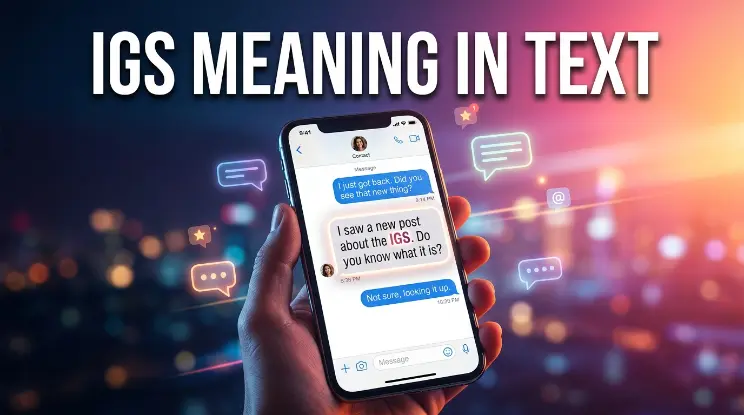
You ask a friend if they’re excited about weekend plans, or you check in on how they’re feeling about something, and the reply comes back short and a little noncommittal: “IGS.” No extra explanation, no clear yes or no, just those three letters leaving you to figure out the actual vibe behind the message.
If you’ve ever paused at a text like that, wondering whether it meant genuine agreement, mild hesitation, or something closer to indifference, you’re definitely not alone. IGS is one of those texting terms that carries a specific emotional flavor once you understand it, but can feel genuinely confusing the first time it shows up in your messages, especially since it doesn’t scream its meaning the way more obvious abbreviations do.
This guide covers everything you need to know about IGS meaning in text what it stands for, the tone it usually carries, where it’s used most, and how to respond when it lands in your conversation. By the end, you’ll know exactly how to read between the lines the next time someone sends you IGS.
What Does “IGS” Mean in Texting?
Let’s get right into it. The IGS meaning in text is most commonly “I Guess So.”
It’s a casual, slightly hesitant way of agreeing with something without fully committing to enthusiasm. Think of it as the texting equivalent of a half-shrug someone isn’t saying no, but they’re also not saying yes with a ton of confidence or excitement either. It sits right in that gray area between agreement and uncertainty.
What makes IGS meaning in text worth understanding is the emotional nuance baked into it. Unlike a plain “yes” or an enthusiastic “yeah!,” IGS often signals mild reluctance, indecision, or a kind of resigned agreement, like someone going along with something even if they’re not fully thrilled about it. That subtle hesitation is really the defining feature of this particular abbreviation.
Full Form / Expansion of “IGS”
The full form of IGS is:
I Guess So
Breaking it down: I stands for “I,” G stands for “Guess,” and S stands for “So.” Together, they form a phrase that expresses mild, somewhat reluctant agreement, rather than confident or enthusiastic confirmation.
You’ll typically see it written in lowercase as “igs” in casual texting, though it can appear capitalized too. It’s sometimes paired with additional punctuation, like “igs…” with trailing dots, which tends to emphasize the hesitation or uncertainty even further.
It’s worth noting that IGS is occasionally confused with “IG,” which is far more commonly known as shorthand for Instagram. While the two look similar and can sometimes appear near each other in casual conversation, they mean completely different things, so it’s worth paying attention to the surrounding context.
Where “IGS” is Commonly Used
IGS shows up across a range of casual digital spaces, especially in conversations involving decisions, opinions, or plans. Here’s where you’ll spot it most.
Group Chats and Everyday Texting
This is probably where IGS appears the most, often in response to a friend proposing plans or asking for an opinion, where the reply lands somewhere between agreement and hesitation.
Dating Apps and Flirty Texting
In dating conversations, IGS sometimes shows up when someone is asked a slightly pointed or personal question, functioning as a noncommittal, cautious response.
Social Media Comments
On platforms like Instagram or TikTok, IGS occasionally appears in comment sections reacting to debates, opinions, or polls, expressing mild, uncertain agreement with a particular take.
Group Decision-Making Chats
When groups are trying to settle on plans, like choosing a restaurant or deciding on an activity, IGS often shows up as a lukewarm way of going along with whatever the majority decides.
Casual Check-In Conversations
IGS frequently appears when someone is asked how they’re feeling about something, offering a vague, uncertain response rather than a clear, definitive answer.
Origin & History of “IGS” as a Texting Abbreviation
IGS developed the way a lot of everyday texting shorthand does, growing naturally out of the broader habit of shortening common phrases during the early days of SMS texting and instant messaging in the 2000s. Since typing on early mobile phones was slow and limited, users regularly compressed frequently used expressions to save time and effort.
“I guess so” is a phrase that comes up constantly in everyday spoken conversation, especially in situations involving mild uncertainty or reluctant agreement. As texting became a primary way people communicated, it made natural sense for such a commonly used phrase to eventually get shortened into an abbreviation, following the same pattern that produced other similar texting shortcuts.
Unlike some slang terms that trace back to a specific viral moment, meme, or cultural reference, IGS emerged more quietly, spreading gradually through everyday casual texting rather than through any single dramatic origin point. Its usage carried over smoothly from early instant messaging platforms into modern texting apps and social media, remaining relevant simply because expressing mild, uncertain agreement is such a common part of everyday conversation.
Today, IGS meaning in text remains a useful, if somewhat understated, way of expressing that particular flavor of hesitant agreement that doesn’t quite fit into a confident yes or a clear no.
Other Possible Meanings of “IGS”
While “I guess so” is by far the most common IGS meaning in text, there are a couple of other contexts and nuances worth knowing about.
1. Instagram Story Reference
In some casual conversations, particularly among people deeply embedded in Instagram culture, “IGS” can occasionally be used loosely to reference an Instagram Story, similar to how “IG” is shorthand for Instagram itself. This usage is far less common than the “I guess so” meaning, but it does show up occasionally.
2. Sarcastic or Dismissive Tone
Depending on punctuation and context, IGS can sometimes carry a slightly sarcastic or dismissive edge, especially if someone uses it as a short, low-effort response to something they don’t feel strongly about.
3. Personal or Regional Shorthand
As with many flexible abbreviations, certain friend groups or online communities may occasionally repurpose IGS for their own specific inside-joke meaning, though this is far less common than its primary use.
For the overwhelming majority of everyday texting, though, if you see IGS in a conversation, it’s safe to assume someone is expressing that particular blend of mild agreement and hesitation.
How to Use “IGS” Correctly
If you want to start using IGS yourself, here’s how to make sure it comes across the way you intend.
Use it when you’re genuinely unsure or hesitant. IGS works best when you actually feel that mild uncertainty, rather than as a substitute for a confident yes.
Add context if you want to explain your hesitation. Pairing IGS with a brief reason, like “igs, but I’m still not totally sure,” helps clarify what’s behind your uncertainty.
Be mindful of how it might land. Since IGS carries a somewhat noncommittal tone, it’s worth considering whether a more enthusiastic response might be more appropriate if you genuinely feel positive about something.
Keep it casual. IGS fits naturally into relaxed, everyday conversations, but isn’t the best choice for situations requiring clear, decisive communication.
Example Conversations/Chat Snippets Using “IGS”
Here are several real-style examples showing how IGS meaning in text plays out across different platforms and situations.
Example 1 Reluctant Agreement to Plans Friend: “want to try that new restaurant tonight?” You: “igs, sure why not”
Example 2 Uncertain Opinion Friend: “do you think this outfit looks good?” You: “igs, maybe try the other one though”
3 Group Chat Decision Friend: “everyone good with pizza for dinner?” You: “igs, works for me”
4 Dating App Conversation Match: “so are you looking for something serious?” You: “igs, still figuring that out honestly”
5 Checking In on Feelings Friend: “you good after everything that happened?” You: “igs, still processing it a bit”
6 Casual Agreement Without Enthusiasm Sibling: “want to watch a movie tonight?” You: “igs, nothing else going on anyway”
7 Reacting to a Suggestion Coworker: “should we push the meeting to next week?” You: “igs, if that works better for everyone”
8 Social Media Comment Comment under a debate-style post: “igs, kind of see both sides tbh”
9 Mild Reluctance About Plans Friend: “you coming to the party this weekend?” You: “igs, might just stay in though”
10 Uncertain Response to a Question Friend: “do you think we should tell them the truth?” You: “igs, might be better in the long run”
IGS Meaning in Chat, WhatsApp, Instagram, TikTok
Across different platforms, the IGS meaning in text stays fairly consistent as a hesitant, mild agreement, though the tone can shift slightly depending on where it’s used. On WhatsApp and everyday texting, IGS often shows up in casual back-and-forth conversations about plans or opinions, carrying that familiar noncommittal energy. Instagram, it occasionally overlaps with references to Instagram Stories, so context matters more here than on other platforms. On TikTok, IGS tends to appear in comment sections reacting to opinions or debates, often expressing partial or uncertain agreement rather than a strong stance either way.
When NOT to Use “IGS”
While IGS fits naturally into casual digital conversations, there are a few settings where it’s better to avoid it.
Professional emails or workplace communication. IGS’s inherently uncertain, casual tone makes it unsuitable for professional settings where clear, confident communication matters most.
Situations requiring a clear decision. If someone genuinely needs a definitive yes or no, responding with IGS can come across as unhelpfully vague or noncommittal.
Conversations with people unfamiliar with texting shorthand. Spelling out “I guess so” fully helps avoid any chance of IGS being misread or misunderstood by someone less used to casual abbreviations.
Serious or emotionally significant conversations. In situations where someone needs genuine reassurance or a clear answer, a vague IGS response might come across as dismissive, even if that’s not the intention.
Similar Texting Abbreviations and How “IGS” is Different from Them
A handful of other abbreviations overlap with IGS in expressing agreement or uncertainty, but each carries its own distinct tone.
Idk (I Don’t Know): Expresses genuine uncertainty without any element of agreement, whereas IGS leans slightly toward agreeing, even if reluctantly.
Sure: A more neutral, straightforward way of agreeing, without the added hesitation that IGS carries.
Meh: Expresses indifference or lack of enthusiasm, similar in tone to IGS, but without directly implying agreement.
Yeah, I Guess: Functionally very similar to IGS, just written out in fuller form rather than abbreviated.
Whatever: Can sometimes carry a more dismissive or slightly frustrated tone compared to the softer, more genuinely uncertain energy of IGS.
Understanding these small distinctions helps you pick the clearest, most appropriate way to express your actual level of certainty or enthusiasm.
How to Respond When Someone Sends You “IGS”
Not sure how to reply when someone texts you IGS? Here’s how to handle it depending on the context.
- If you want to offer reassurance: Following up with “no worries if you’re not totally sure” gives them space without pressure.
- If you want more clarity: Asking “wait, are you actually down or just going along with it?” helps get a clearer answer.
- If it’s a low-stakes decision: A simple “okay, sounds good” works fine without needing to dig deeper.
- If it follows a check-in about feelings: Responding with “that’s okay, take your time” acknowledges their uncertainty with care.
Common Mistakes/Misunderstandings Around “IGS”
Even though IGS is fairly straightforward once understood, a few common mix-ups still happen.
Confusing it with IG. Since IGS looks similar to “IG,” the common shorthand for Instagram, people sometimes misread the intended meaning, especially in social media-heavy conversations.
Reading it as full enthusiasm. Because IGS technically expresses agreement, some people mistakenly interpret it as more confident or excited than it actually is.
Missing the hesitation behind it. Since text lacks vocal tone, the subtle reluctance embedded in IGS can sometimes get overlooked, especially by people less familiar with the term.
Using it when a clearer answer is needed. Relying on IGS in situations that genuinely require a firm decision can lead to frustrating back-and-forth as the other person tries to figure out where you actually stand.
FAQs About IGS Meaning in Text
What does IGS mean in a text message?
IGS stands for “I Guess So,” used to express mild, somewhat reluctant agreement rather than confident or enthusiastic confirmation.
Is IGS meaning in text the same as saying yes?
Not exactly. While IGS does lean toward agreement, it carries a noticeable undertone of hesitation or uncertainty compared to a straightforward, confident yes.
Can IGS mean something related to Instagram?
Occasionally, though far less commonly, IGS can loosely reference Instagram Stories in some casual conversations, similar to how “IG” refers to Instagram itself.
Is IGS considered a negative response?
Not necessarily negative, but it does carry a lukewarm, noncommittal tone rather than genuine enthusiasm or confidence.
How do I know if someone means “I guess so” or something else by IGS?
Context is key. If it follows a question about plans, opinions, or feelings, it almost certainly means “I guess so.” Other meanings are rare and usually clear from the surrounding conversation.
Is it okay to use IGS in professional settings?
No, IGS is casual texting slang and isn’t appropriate for professional emails or formal workplace communication, especially since it can come across as vague or uncertain.
Conclusion
At the end of the day, IGS meaning in text captures a very specific, relatable feeling: that lukewarm, slightly hesitant agreement that doesn’t quite reach full enthusiasm but isn’t a clear no either. It stands for “I Guess So,” and it’s used exactly the way it sounds a casual, somewhat uncertain way of going along with something.
Whether you’re seeing it as a reluctant agreement to weekend plans, a noncommittal answer on a dating app, or a vague reaction in a group chat decision, IGS carries a specific emotional texture that’s worth understanding correctly. Now that you know the full IGS meaning in text, you’ll be able to read that subtle hesitation clearly and respond with the right amount of understanding whenever it shows up in your own conversations.

Hi, I’m Henry Walker, a language enthusiast and content writer at Meanzafy.com. I enjoy exploring the meanings behind words, slang, abbreviations, text messages, and everyday expressions to make English easier for everyone. My goal is to create clear, accurate, and easy-to-read guides that help readers quickly understand confusing terms and use them with confidence. Whether you’re looking for the meaning of a text abbreviation or the explanation of a common phrase, I’m here to provide reliable, beginner-friendly content you can trust.